

Today we're launching a new format on Conversion Club: conversations with experts from the e-commerce ecosystem, practitioners who work hands-on with the tools and have enough perspective to talk about them with precision.
For this first conversation, we met with Hugo Nicole, an independent CRM consultant and Klaviyo specialist.
Hugo works with a wide range of brands, from stores just starting to structure their email channel to those managing a base of tens of thousands of contacts with a dedicated team.
That range gives him a comparative view few practitioners have. He can diagnose the state of an email strategy in a handful of questions, and what he finds often says more about a brand's real priorities than about its reported performance.
How do you assess a client's email maturity when you start working with them?
I start by asking what automations they have in place and how often they send campaigns.
You quickly see the difference between a brand that has a welcome email, an abandoned cart email (sometimes not even sent from Klaviyo), and sends a weekly newsletter to its whole list, and a brand that is far less structured and sends only two or three emails a year to its entire list.
I had one recently: a watchmaker with a base of 20,000 contacts, an incredible product and very strong revenue.
They sent three emails a year because they were afraid of bothering their audience. They were missing a huge opportunity, even though they have everything they need to create content their contacts would love.
Then there's a KPI I always look at: the share of revenue attributed to email in Klaviyo. That number doesn't always reflect reality, since attribution is a real issue, but it lets me compare brands with each other.
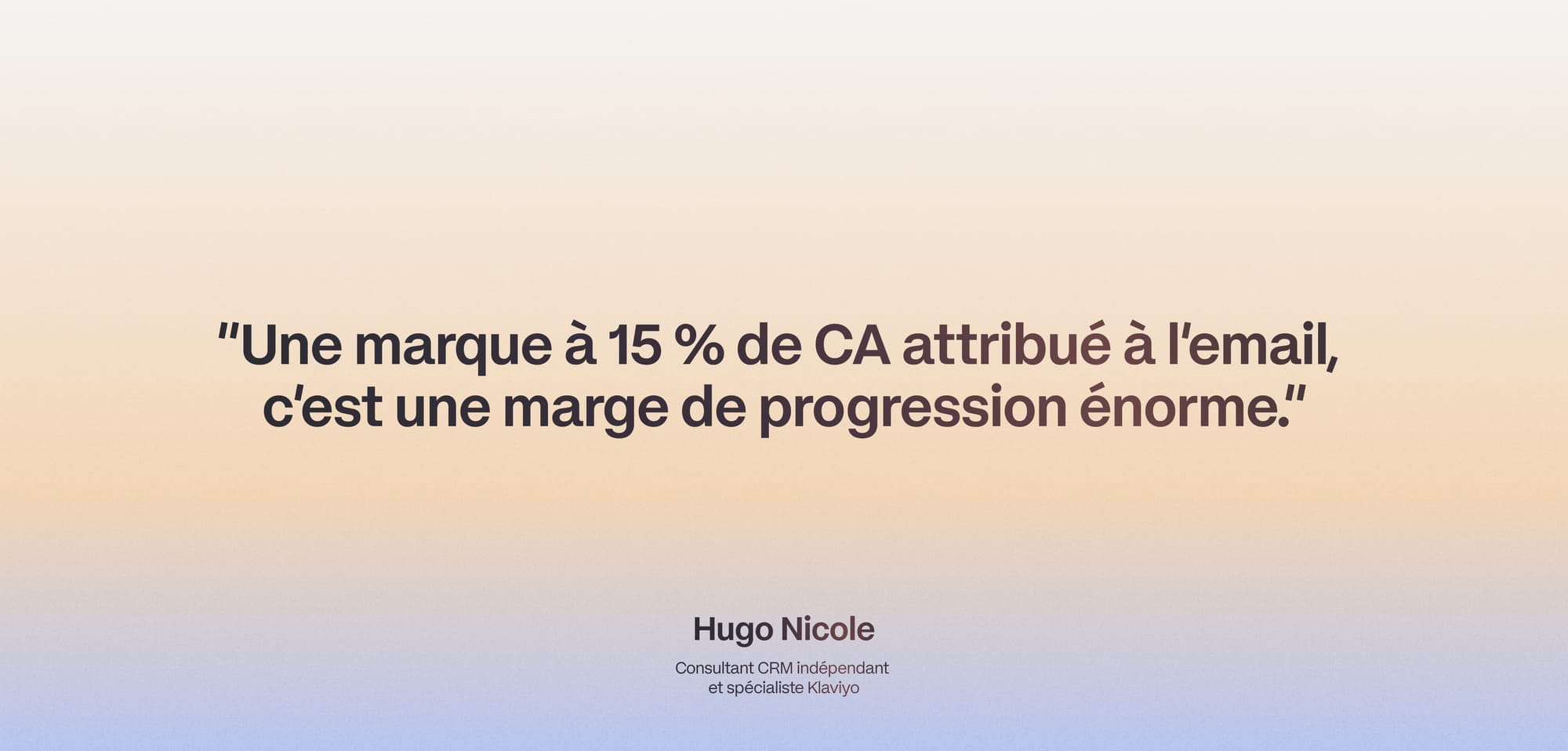
A brand at 40-50% already has something solid.
In terms of extra revenue to get from email alone, it will be hard. The room for improvement lies more in the customer experience and covering the full journey.
When you step into an account, how do you prioritize? Do you lock down the automations first, or try to understand the audience through campaigns first?
In every case, we start with the core automations:
- the welcome series,
- the abandoned cart,
- and what I call browse abandonment, meaning when someone leaves the site without going past a product page.
These three flows cover the hottest moments of the customer journey, where you get the best open and click rates.
At the start of a strategy, that matters: it sends positive signals to email providers and builds your deliverability.
At the same time, we launch a weekly newsletter. Just one, not two or three.
The goal is to see how your list reacts.
If your open rates are above 40%, you're following best practices.
Below that, it's the signal to start segmenting by engagement: who opened, clicked or was recently active on the site. That's where you start going after performance.
Here, Hugo talks about the foundations of an email strategy: welcome series, abandoned cart, browse abandonment. If you want to go further on setting up these flows, we've compiled the email marketing best practices to know before you start 👇
 Jérémie Werner

Segmentation is often presented as the key to everything. At what point do you consider it truly useful, and when does it become noise?
You have to distinguish two things: data collection and active segmentation.
You can and should collect data from the start, whatever the brand's maturity. With the Klaviyo-site integration, you automatically capture browsing data, products purchased and email engagement.
And at opt-in, you can already collect preferences: a cosmetics brand can ask whether the person is more into skincare, fragrance or makeup.
That data will be valuable later.
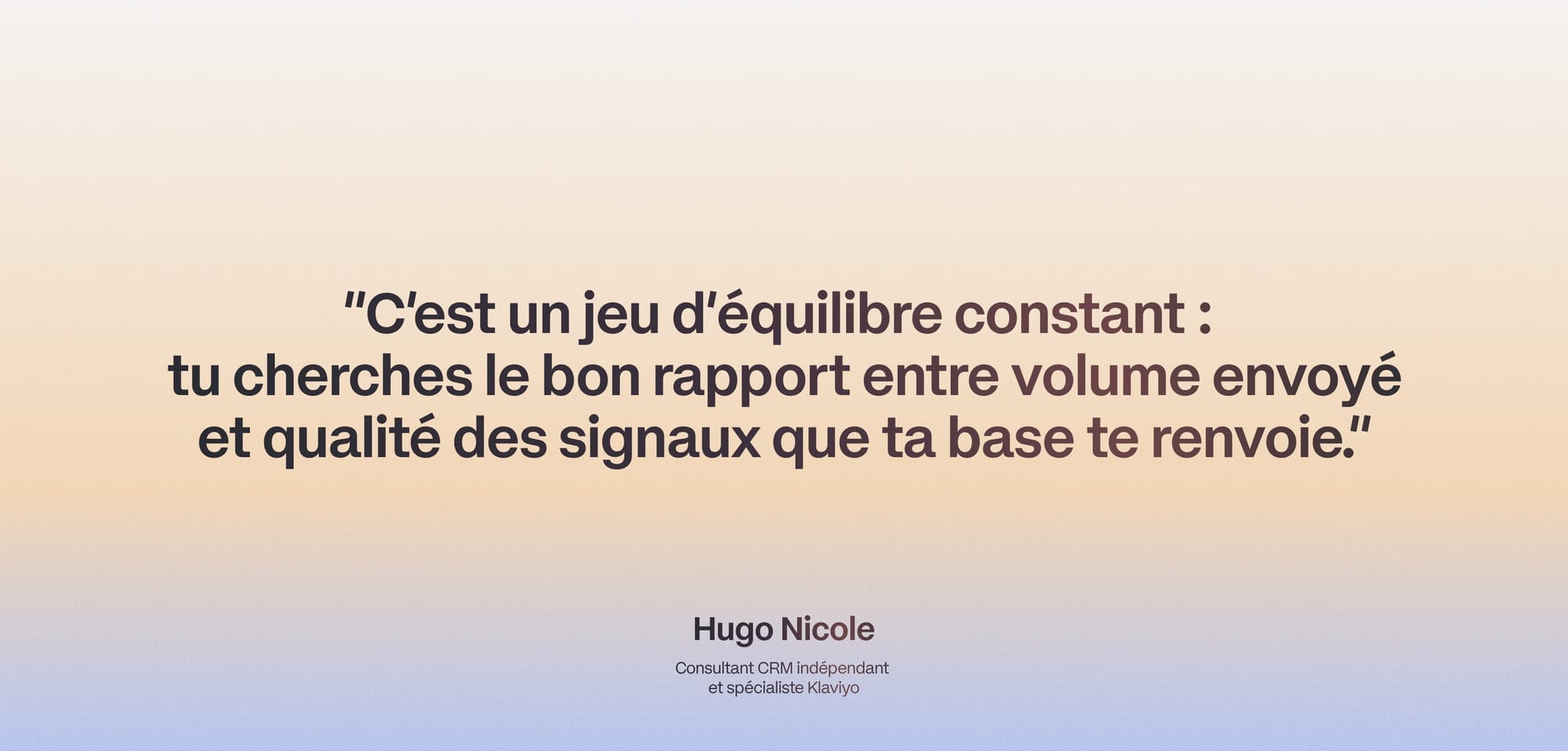
Engagement-based segmentation is a baseline for every brand. The idea is to play with time windows: the last 30, 90 and 180 days.
A brand with a 20% open rate that sends to its whole list will target people engaged in the last 90 days to aim for 45-50% instead. Conversely, a brand with a 70% open rate on its 90-day engaged segment (I had a case just yesterday) needs to widen its criteria to reach more volume.
More advanced segmentation, based on product interests or purchase history, comes second. Many brands set it aside because they don't have the time, and below a certain revenue threshold, the impact on sales isn't necessarily there.
Sometimes brands sacrifice a bit of customer experience for the sake of their time and profitability, and that's a defensible decision.
How do you think about the relationship between email and the on-site conversion funnel? Can email make up for problems that exist elsewhere?
The two really work together.
If your checkout experience is broken, email won't make up for much. Some brands force customers to create an account to place an order. For some that's justified, but for others it's simply a bad customer journey, and a follow-up email won't make people more willing to create an account.
On the other hand, there are points where email can truly complete what the site doesn't do well.
Say someone abandons a cart and didn't notice that shipping is free above a certain threshold, or that they can pay in three installments. If I highlight that in the email, it can unlock the conversion. The information was there, but it wasn't accessible. Email makes it visible at the right moment.
Many brands complain that their list isn't growing and assume the pop-up is poorly optimized. But often, the problem is that there's no traffic on the site. It's a whole system working together.
On Klaviyo specifically: which features do you see underused the most?
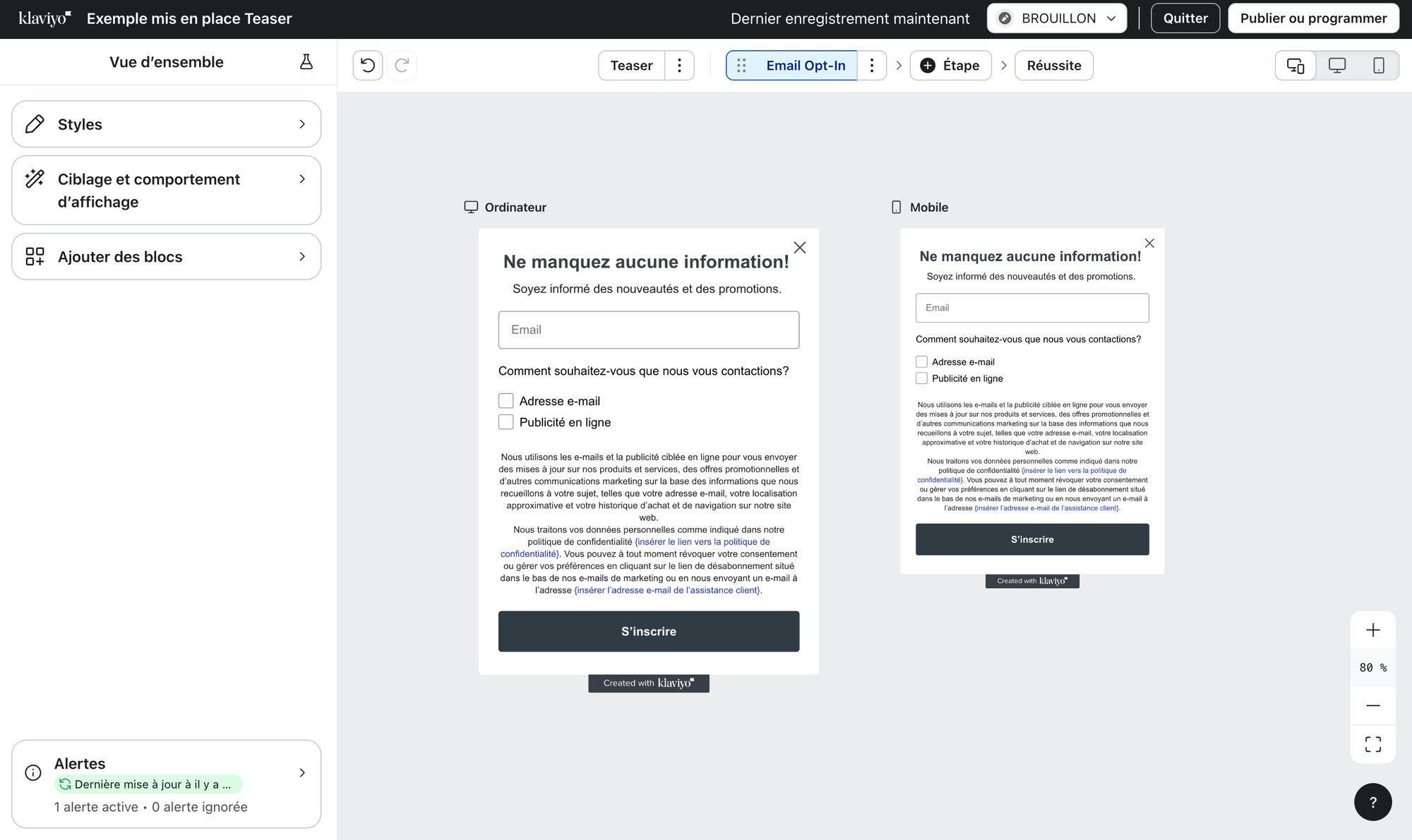
The first is the teaser.
It's a small, discreet widget that appears at the bottom of the page and that visitors can open at any point while browsing. A classic pop-up shows once, the person closes it, and that's it. The teaser stays there, available if they change their mind during their visit. I see it used very rarely, and when it's set up, it really improves capture rates.
Next, the abandoned cart.
Many brands stop at one or two emails. You need at least three to cover this flow properly. That's about the break-even point. Brands that stay at one or two are clearly missing part of their potential.
And then there's SMS and WhatsApp.
They're incredibly underused. These channels work very well alongside email, especially for reaching an audience that is much more active in their messaging apps than in their inbox.
Brands that get into them see results.
On send timing: do you have a particular approach, or do the tools have enough data to automate it?
For automations, it's fairly simple: you follow up at the same time of day the person was active. If someone gave you their email at 1 a.m., you follow up 24 hours later at 1 a.m., because that's presumably a time when they're in front of their screen.
The data is there. It's ultra-personalization by nature.
For campaigns, things are changing fast.
More and more systems let you send at each contact's usual open time. I think we'll move more and more in that direction, and AI tools are very powerful for this.
For now, brands test: several days first to identify the best slot, then several times of day on that day. Klaviyo has features to spread sends over 24 hours and visualize the peaks.
It's iterative, but it works.
In 5 years, do you see AI fundamentally changing the profession, or mostly speeding up what already exists?
I think it will be unrecognizable.
I can already see it in one year. It feels like half my days are spent doing things completely different from what I did two years ago: a lot of automating my own processes and thinking about how to delegate tasks to systems. And it takes up more and more space.
I think what I do today won't exist in a few years.
It will be built into tools like Klaviyo, which will cut out many of the intermediaries between brands and their tools. Brands will be able to focus on what truly remains theirs: brand image, storytelling, their DNA. And behind that, very high-performing systems will run strategies automatically, with no human intervention for each decision.
Klaviyo has the data for it. They have the volume of customers, the content samples, and they know what works in each market.
It's just a matter of time before machines absorb and automate that learning.
What's interesting in this scenario is what it means for brands when it comes to identity. It's a bit like what brands such as Louis Vuitton already do with their sales force: thousands of salespeople around the world, with different cultures and backgrounds, but everyone delivers "the Vuitton experience."

We'll have to brief AI the same way: give it the identity criteria, the tone and the service standards, so it can adapt to each customer while staying consistent.
It's a huge opportunity for brands with a strong personality. Marketers are going to have a blast.
To go further with Hugo, check out his thoughts on CRM and email marketing on The Emailist, his site dedicated to email strategies for e-commerce brands, as well as his newsletter on Substack.
He's also active on LinkedIn, where he regularly shares his take on how the profession is evolving.
💐✌️