1+1=3 - The beauty of this equation is that it's exponential.
- 1 brand + 1 customer = 1 brand + 2 customers
- 1 brand + 2 customers = 1 brand + 4 customers
- 1 brand + 4 customers = 1 brand + 8 customers
- 1 brand + 8 customers = 1 brand + 16 customers
Then 32, 64, 128, 256, 512, 1024... There you go: your acquisition now looks like a game of 2048.
Welcome to the "growth loop": a world where your existing users become the main engine of your acquisition.
Unlike a traditional sales funnel that runs out of steam, the loop is circular and its potential is exponential. The challenge is no longer how to fill the top of your funnel, but how to turn your customers into your best marketing channel.
So you want to loop your business?

Have you met Yacine?
Two years ago, I met Yacine, the founder of the brand YParis. At the time, the brand was riding the trend for earcuffs, a type of jewelry that has since built its own market.
What strikes me about Yacine is how closely he listens. Whenever he shares stories about his customers, he takes the time to listen, take notes, and adopt a methodical, problem-solving approach.
Thanks to this ability to listen, his confidence in his project, and his agility in adapting, his e-commerce store recorded revenue growth of +848% in 2025.
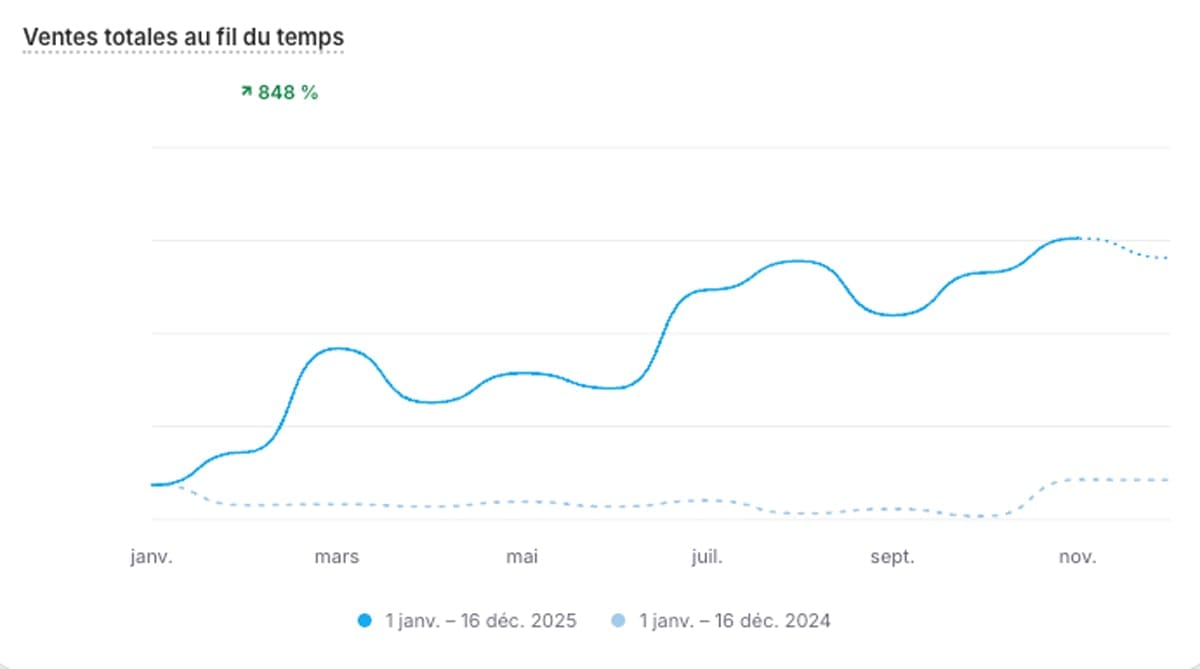
Break down the strategy and it's simple, which is what makes it effective. Once the product found its market, scaling paid happened naturally and gradually. The marketing mix is proven and has settled into a routine, with Meta dominant (Sales + Lead) tied to Klaviyo.
The setup was firing on all cylinders, and the acquisition machine ran well. That raised the question of scaling and of dependence on this model.
How do you generate value from customers who have already converted?
The behavior Yacine describes in store is creating and buying "ear compositions." In store, the sales staff can sell several pieces of jewelry to build those compositions.
There is no sales staff online, so YParis had to work on a timeline that creates repeat purchases. That's where a retargeting approach came in, aiming to increase the number of orders per buyer by playing on the idea of composition.
The idea: increase the number of orders per buyer by playing on the idea of composition
After iterating, the average number of orders per customer gradually rose by 0.2 points. It's not yet a loop, but a step forward was made: return on investment is better and CLTV (Customer Lifetime Value) is rising.

What if we thought about 1+1=3?
YParis customers behave almost like activists. This observation opens up avenues for thinking about community, shared codes, and viral fashion.
While we were talking strategy, a taboo subject came up out of nowhere:
"It's annoying when sites hand out promo codes left and right..."
Back to basics!
That remark became the cornerstone of the solution for creating the loop: it wasn't enough to create promo codes, they also had to encourage customers to share them. The trade-off is selling for less, but getting results from the money you don't give to Meta to acquire customers.
The reasoning then became clear: what is the average (blended) acquisition cost today? For YParis to take on the challenge, new customers brought in by existing ones had to come at a cost lower than or equal to that acquisition cost.

The solution: a simple Klaviyo loop
V1 of the loop has been live and running since 2025. It's nothing more than a simple one-email CRM flow, not pushy, not spammy, that triggers on purchase and invites the buyer to give a promo code to friends and family.
Clicking the CTA in the post-purchase email opens a WhatsApp link-sharing conversation to incentivize sharing for YParis.
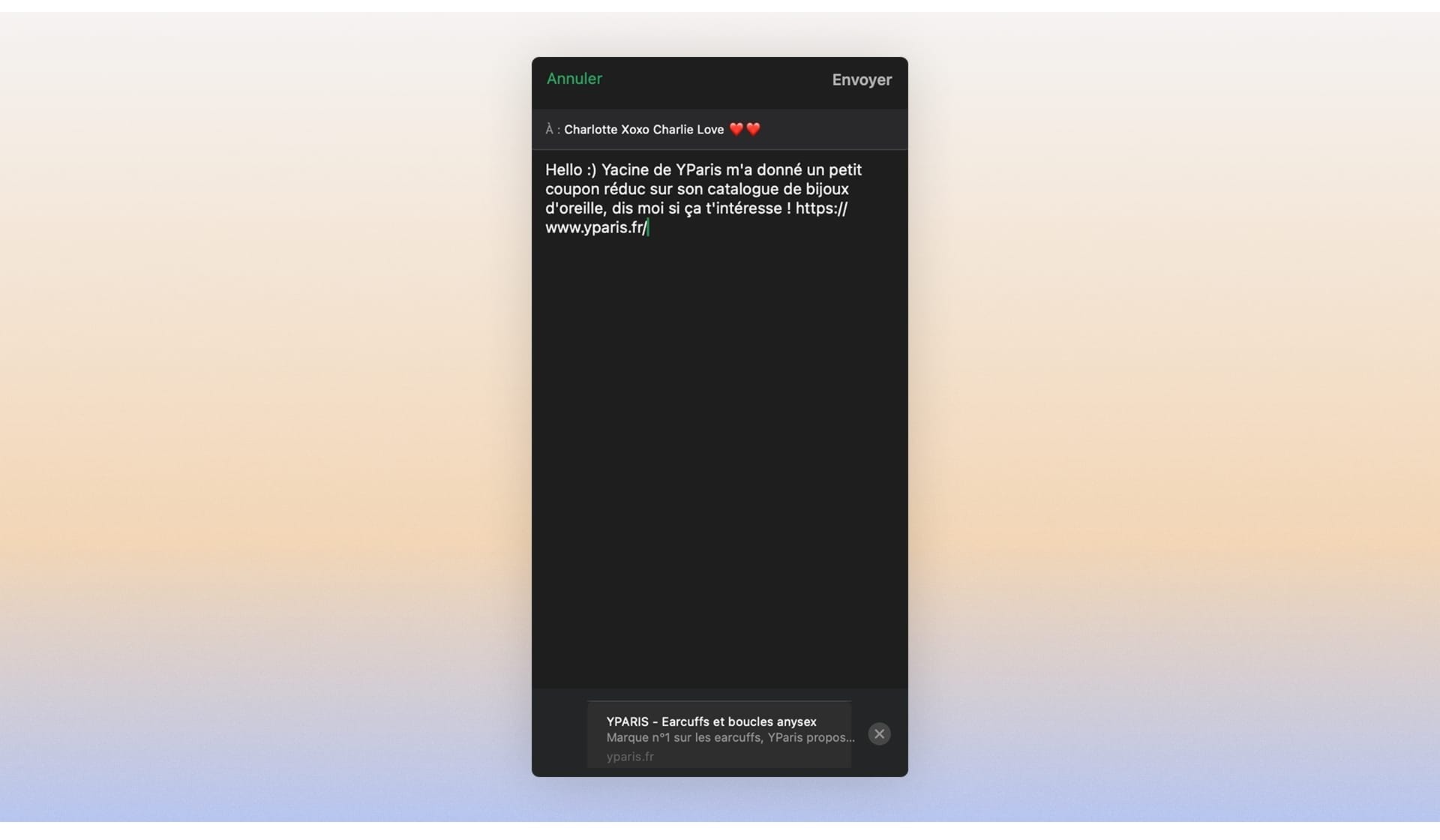
Today, this loop accounts for 7% of orders placed in 2025. Nice score, right?
We could have some fun with projections. They would only show potential, not real conditions, but it's still a fun exercise.
This type of loop works a bit like compound interest.
At first, the effects are modest. But as time passes, each action feeds the next.
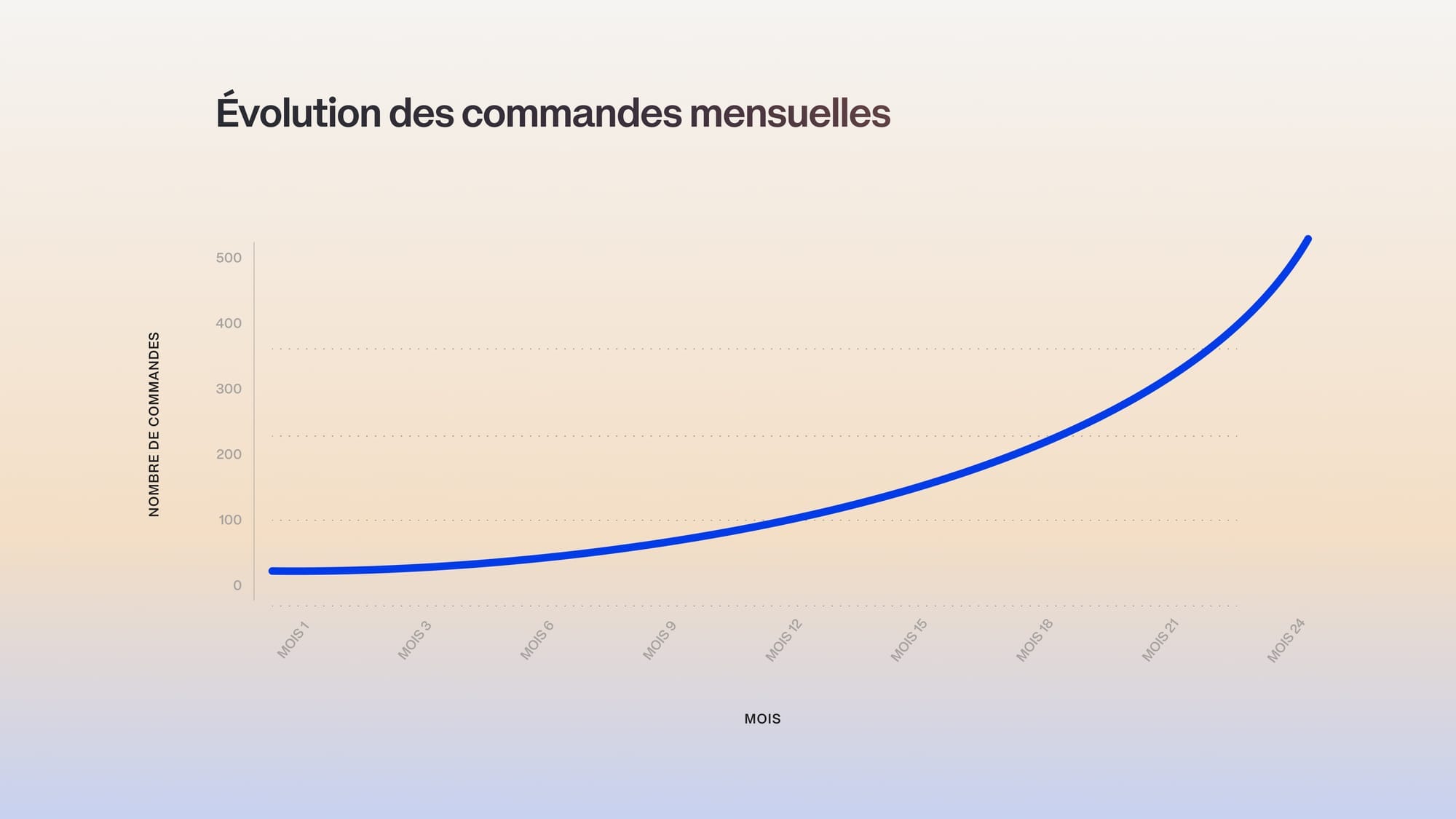
Growth no longer comes from a one-off effort, but from accumulation. That's what makes the model especially healthy: it rests on a shared interest. The brand gains efficiency, and customers get a good reason to recommend it.
When interests are aligned, growth becomes a consequence, not a goal to chase at a forced march.
Growth Loop and AARRR: A Custom Funnel
For years, you've been taught to think in terms of a conversion funnel:
This linear model works on a simple principle: you pour resources, often ad spend, into the top of the funnel to get customers out the other end.
The problem? As soon as you cut or stop the budget, the flow stops. It's a demanding system that takes constant effort to keep the momentum going.
The growth loop model, by contrast, relies on a circular, self-feeding logic. Here, each step feeds the next: the output of one step (for example, a satisfied customer) becomes the input of the next (they leave a positive review that attracts new customers).

Each cycle creates growth momentum that feeds the next.
The result: a sustainable, scalable growth machine where your own users become the engines of acquisition.