When your customer hands their cart to an AI
Your next customer won't click through your site. They won't see your hero banner, scroll your homepage or linger over your gorgeous spring-summer collection.
They'll message their AI assistant, and the assistant will decide, in a few milliseconds, whether your product deserves a recommendation. Or gets ignored.
We're entering the era of agentic e-commerce: one where robots do the shopping instead of humans. And if your store isn't ready to speak their language, it risks becoming invisible.
In this article, I'll show you what changes, what stays the same, and above all what you can do right now so that AI agents become your best ambassadors.
Just a few months ago, your customers typed "best moisturizer for dry skin" into Google, clicked on a dozen links, skimmed a few reviews, then added three shortlisted products to their cart.
Today, they open ChatGPT and simply say: "I'm looking for a lightweight moisturizer for combination skin, under €40, not tested on animals, and delivered in France before Friday."
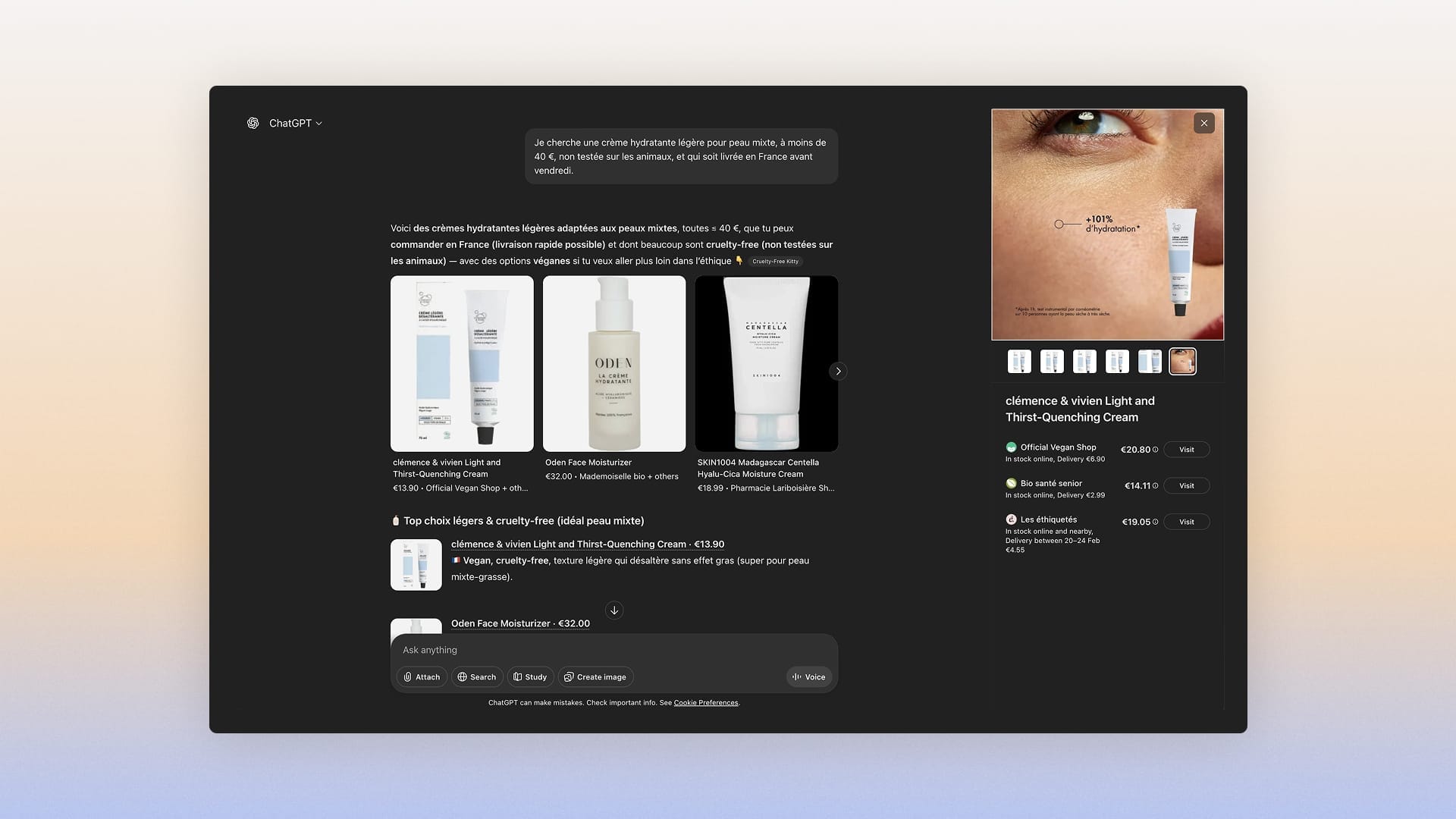
In seconds, the AI agent scans structured product data across dozens of stores, compares prices and reviews, checks the delivery window and offers a selection right in the interface. Then it completes the transaction with a single word in the chat.
This is what we call agentic e-commerce: a world where customers delegate discovery, evaluation and ordering to their little robots.
You don't need to be a hardcore geek to care: the numbers are impossible to ignore. AI-generated traffic in the US jumped 4,700% in less than a year, and the market is estimated at $300 to $500 billion by 2030.
AI has kicked off an era of hypergrowth: everything is accelerating, and ChatGPT already drives 20% of Walmart's traffic, the largest supermarket chain in the US. In Europe, Zara's traffic jumped 16% between June and August 2025.
The implication for our industry is unmistakable: your next "visitor" won't necessarily be human. The rules of conversion are being turned upside down.
From search to conversation: understanding what changed
TOFU-MOFU-BOFU
The e-commerce journey has been well mapped for years and can be summed up like this:
This funnel segmentation is what gave us the famous TOFU-MOFU-BOFU.
The underlying logic hasn't changed, but phases that were sometimes spread over a relatively long period are now compressed into a single conversation thread. The AI agent handles everything, and users don't even have to leave its interface:
- On ChatGPT Shopping: an integrated shopping experience that generates curated product picks. OpenAI has built partnerships with the biggest players, including Shopify, to let users buy directly through the Agentic Commerce Protocol (ACP), co-developed with Stripe.
- On Perplexity: the Buy with Pro alternative, which offers similar features through a partnership with PayPal.
- On Google: purchase options are gradually appearing in Gemini conversations, along with advanced features like automatic price tracking and automatic purchasing based on predefined criteria.
This seemingly minor shift is decisive: the only parts of your brand strategy that stay visible are the data the interface displays, nothing more, nothing less.
Brand campaign for The Nue Co. by Unfound Studio
TL;DR: the AI agent doesn't care about your brand world
I hope I won't regret this sentence in some dystopian future: being a good machine, the AI agent is immune to marketing narratives and emotional design.
It methodically analyzes structured product data, built expressly to be read by machines: price, availability, customer reviews, technical specifications, delivery and return terms…
Its decisions aren't instinctive. They're logical and aligned with what its user asked for.
And needless to say, cryptic phrases like "Our signature hydration experience" don't move our little robot.
But nicely structured JSON-LD data stating:
- Lightweight moisturizing gel
- 50 ml
- for combination skin
- with hyaluronic acid
- €34.90
- in stock
- ships within 24 hours
- 30-day returns
might almost give it a brief thrill.
It may not look like much, yet it completely changes the game.
The new equation for optimizing conversions becomes:

The GEO framework: Generative Engine Optimization
SEO was a long-haul race to get your brand to the top of a list of links. GEO is about doing everything you can to get cited and recommended by LLMs in their answers.
In practice, there are three main pillars to optimize: structured data, intent-driven product content and trust signals.
Optimize the structured data on your product pages (JSON-LD / Schema.org)
This is hands down the most important technical driver, if not an outright must. LLMs treat structured data as their absolute "source of truth" for verifying the information they find in the rest of your content.
For proof, just read the findings of the Data World study, which show that GPT-4's accuracy jumped from 16% to 54% when content was supplemented with structured data.
More broadly, pages with this valuable metadata get nearly a third more clicks.
The essential schema types for e-commerce:
| Schema type | Purpose | How the AI agent uses it |
|---|---|---|
Product |
Core product attributes (name, SKU, price, availability, materials, dimensions) | Product discovery, comparison and purchase |
Offer |
Price, currency, availability, delivery details | Price comparison, choosing delivery options |
AggregateRating / Review |
Rating, review count, customer testimonials | Trust signals and ranking |
FAQPage |
Structured Q&A about products and shipping and return policies | Answering the user's questions in the chat |
Organization |
Brand identity, contact details, social media profiles | Brand verification and reputation |
BreadcrumbList |
Site architecture and product categorization | Understanding categories |
HowTo |
Usage information | Contextual recommendations |
ReturnPolicy / ShippingDetails |
Shipping costs and speed, return terms | Decision support to validate the transaction |
Example: JSON-LD markup for a product page, optimized for AI agents
<script type="application/ld+json">
{
  "@context": "https://schema.org",
  "@type": "Product",
  "name": "Gel hydratant Hydra-Light – Peaux mixtes",
  "brand": {
    "@type": "Brand",
    "name": "Conversion Club"
  },
  "description": "Gel hydratant léger formulé pour les peaux mixtes. Contient de l'acide hyaluronique et de la niacinamide. Sans huile. Convient à une utilisation quotidienne. 50 ml.",
  "sku": "MV-HLG-50",
  "gtin13": "3760012345678",
  "image": "https://conversion.club/images/hydra-light-gel-50ml.jpg",
  "material": "Acide hyaluronique, niacinamide, aloe vera",
  "audience": {
    "@type": "PeopleAudience",
    "suggestedGender": "unisex",
    "suggestedMinAge": 18
  },
  "offers": {
    "@type": "Offer",
    "url": "https://conversion.club/hydra-light-gel",
    "priceCurrency": "EUR",
    "price": "34.90",
    "availability": "https://schema.org/InStock",
    "itemCondition": "https://schema.org/NewCondition",
    "priceValidUntil": "2026-12-31",
    "shippingDetails": {
      "@type": "OfferShippingDetails",
      "shippingRate": {
        "@type": "MonetaryAmount",
        "value": "0",
        "currency": "EUR"
      },
      "deliveryTime": {
        "@type": "ShippingDeliveryTime",
        "handlingTime": {
          "@type": "QuantitativeValue",
          "minValue": 0,
          "maxValue": 1,
          "unitCode": "DAY"
        },
        "transitTime": {
          "@type": "QuantitativeValue",
          "minValue": 1,
          "maxValue": 3,
          "unitCode": "DAY"
        }
      },
      "shippingDestination": {
        "@type": "DefinedRegion",
        "addressCountry": "FR"
      }
    },
    "hasMerchantReturnPolicy": {
      "@type": "MerchantReturnPolicy",
      "returnPolicyCategory": "https://schema.org/MerchantReturnFiniteReturnWindow",
      "merchantReturnDays": 30,
      "returnMethod": "https://schema.org/ReturnByMail",
      "returnFees": "https://schema.org/FreeReturn"
    }
  },
  "aggregateRating": {
    "@type": "AggregateRating",
    "ratingValue": "4.6",
    "reviewCount": "238",
    "bestRating": "5"
  },
  "review": [
    {
      "@type": "Review",
      "author": { "@type": "Person", "name": "Jeremie W." },
      "reviewRating": {
        "@type": "Rating",
        "ratingValue": "5"
      },
      "reviewBody": "Parfait pour ma peau mixte. Pénètre rapidement, sans laisser de film gras."
    }
  ]
}
</script>
Once again, this technical optimization is crucial. When a user asks ChatGPT:
What's a good gel moisturizer for combination skin under €40 with free delivery in France?
This product will have every signal the agent needs to feature it with confidence. Without this markup, the same product, beautifully staged on its gorgeous product page, might never show up!
Create intent-driven product content
AI agents interpret natural-language queries that are much longer and more specific than the keyword searches of the old world: 23 words on average versus 4 for a Google search.
The content describing your product needs to match that depth of conversation.
Before:
"Discover our iconic Hydra-Light gel, the ultimate hydrating experience for modern skin. Feel the difference."
After:
"Lightweight moisturizing gel for combination skin. Its oil-free formula with hyaluronic acid and niacinamide hydrates without clogging pores. Absorbs in under 30 seconds and works great as a base for makeup and sunscreen. Ideal for humid climates. 50 ml, about 8 weeks of daily use."
In practice, there are 4 key principles to follow to optimize your content for agents:
- Lean on features, not superlatives: replace "incredible," "extraordinary" and "game-changer" with measurable attributes: weight, dimensions, ingredients, capacity or compatibility.
- Address use cases: think like someone describing their need to a personal shopper: "I need running shoes for mountain trail runs, sometimes in the rain," rather than "premium running shoes" :)
- Include details that make comparison easier: materials, certifications (cruelty-free, organic, OEKO-TEX) or long-term care instructions.
- Spell out the question behind the question: an AI agent answering "Is this moisturizer suitable for acne-prone skin?" needs your product description to answer that question outright, not leave the answer implied.
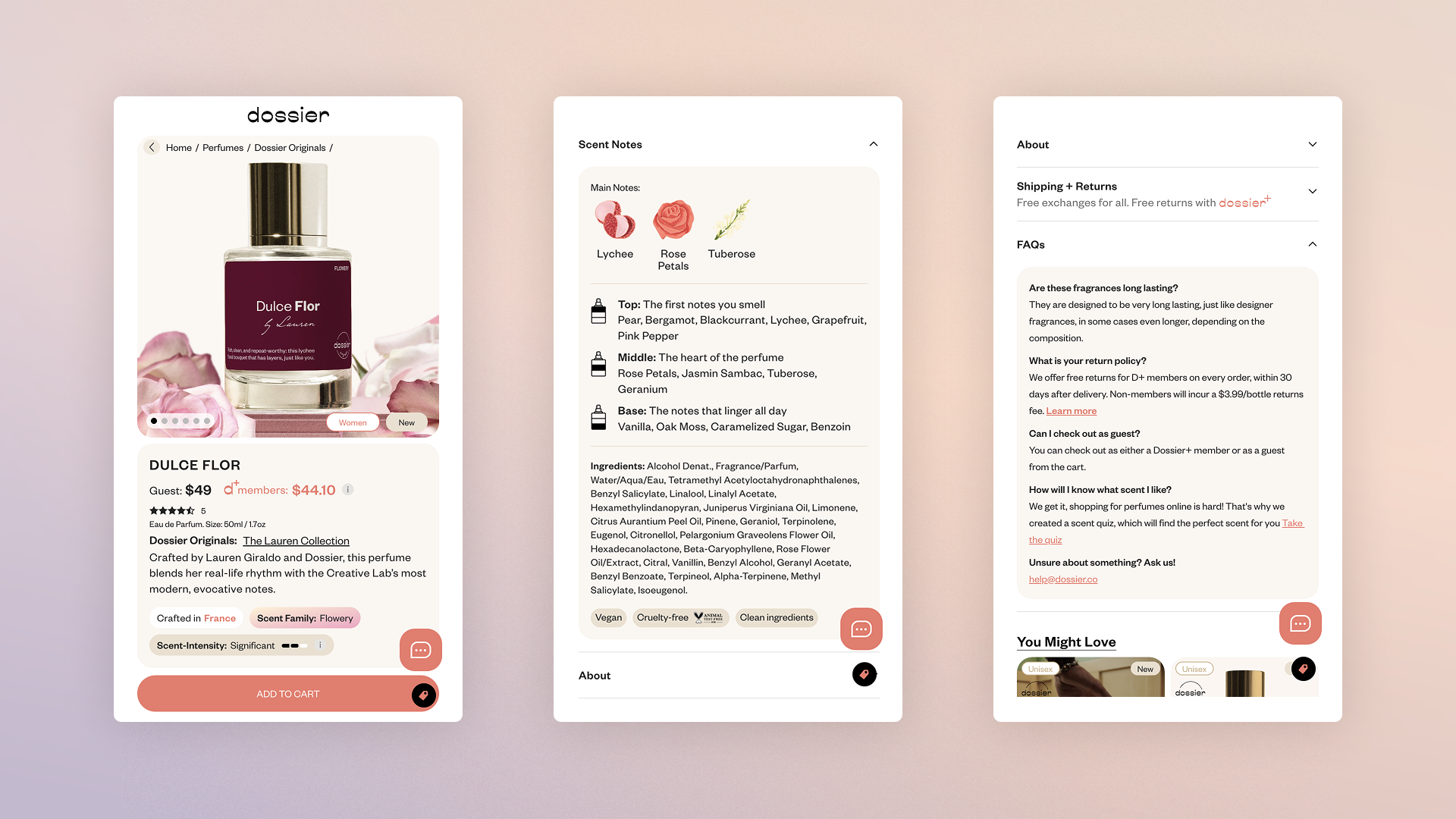
The rule is simple: do your best to anticipate what might interest or concern your audience, get ahead of their expectations and format the answers in a structured way for the conversational agents that will interpret them.
Translate proof of trust into machine language
Unsurprisingly, agents place a high value on trust signals, because they have to take a position themselves and give relevant recommendations.
If an agent promotes a particular product and the customer experience turns out to be disappointing, trust in AI as a whole erodes. So platforms take no risks and promote stores with strong authority and verifiable proof of trust.
There are 4 main trust signals:
- Customer ratings and reviews: structured ratings in microdata format (see above) and individual testimonials. AI agents read these to pick up on emotions tied to satisfaction or complaints.
- A crystal-clear return and shipping policy, identified with the
MerchantReturnPolicyandOfferShippingDetailsschemas. If an agent can't confirm your return policy, it may simply exclude you. - Your brand's legitimacy: organization schema marked up with
sameAslinks to social media profiles and verifiable legal information. - Content freshness: real-time updates to prices and stock. Showing outdated data (for example "In stock" when the product isn't) jeopardizes the transaction, and worse, teaches the agent to deprioritize you in the future. And a robot that strikes you off its list isn't something you can patch up over coffee.
Optimize your Shopify store for agentic commerce

Native features to get ready to win new channels
If you follow Shopify news, you've probably already realized that the platform is one of the pioneers in the race for agentic e-commerce, thanks in particular to its flagship feature Agentic Storefronts, unveiled at the Winter '26 Edition in January 2026.
In practice, Shopify natively offers 5 main features to help you roll out your catalog on LLM platforms:
Shopify Catalog
This is the backbone of the system: Shopify automatically structures your product data (title, description, options, images, price, availability and key attributes) in a format AI agents can interpret.
The feature uses signals from millions of merchants to interpret categories, extract attributes, consolidate variants and group identical items.
Agentic Storefronts sales channel
With one click, you can activate the different channels and start selling on ChatGPT (Instant Checkout), Microsoft Copilot (Copilot Checkout), Google AI Mode and Gemini Checkout, as well as Perplexity.
Shopify catalog structure
If you use metafields, metaobjects, tag prefixes or other specific naming conventions, you'll be able to customize how Shopify interprets them to categorize and present your products to AI agents.
In short, you'll be able to define a series of mappings between your product data and Shopify's standard taxonomy so agents understand the structure of your catalog.
Order attribution
Every order placed through an agent shows up in your Shopify admin with precise attribution, so you can tell exactly which platform generated the sale.
Product availability controls
You choose which products are available for direct purchase through AI platforms and which can only be bought after redirecting to your store.

A little more patience
Unfortunately, these features aren't available in France yet, but that shouldn't take long 🥁! Until then, here's what you can do to prepare:
- Install the Knowledge Base app to control your brand messaging and FAQs, so AI agents can analyze you accurately once the feature becomes available internationally.
- Make sure your descriptions are clear and well structured (attributes, metafields). Shopify Catalog uses specialized LLMs to categorize and enrich your product data, and they need precise inputs.
- Once again, clarify your store policies (shipping, returns, terms of sale) and check that they're accurate.

To learn more, check out the checklist: how to prepare your Shopify store for AI agents
CRO implications: will your funnel collapse?

What's going to change?
In agentic commerce, there's no browsing phase anymore. The little robot arrives with strong intent (satisfying its user) and precise criteria: your product matches or it doesn't, period.
Conversion optimization therefore splits in two, because you're now optimizing for two very different types of visitors:
- humans (traditional CRO)
- and AI agents (data completeness, schema accuracy, trust signals)
The approaches overlap, but they aren't identical.
Product data is the conversion driver:
Studies show that AI traffic currently converts poorly for many retailers. The cause isn't a lack of demand, but friction from the merchant's infrastructure (outdated stock, incomplete data, inconsistent prices).
Brand storytelling now centers on structured attributes:
Agents can't "feel" your brand story. But they can surface features like "cruelty-free, organic cotton, handmade in Portugal, GOTS-certified," which may resonate even more strongly with today's shoppers, who care about ethical values.

What isn't going to change?
Trust remains paramount, and reviews, social proof and clear policies matter more than ever, because agents use them as ranking criteria.
The experience (UX) on the merchant's site remains crucial, since most customer journeys today still end with a redirect to the merchant's site. And even for a payment made in chat, the post-purchase experience (packaging, delivery, returns) determines whether agents will recommend you again. Disappoint a human, and you lose a customer. Disappoint an agent, and you lose thousands.
Testing and iteration, unsurprisingly, remain the key to success:
- Test different product descriptions (conversational vs. traditional)
- Identify the best-performing AI channels
- Track attribution
The fundamental principles of CRO still apply. Only the parameters change.
New metrics to track
| Metric | What it measures | How to track it |
|---|---|---|
| AI channel attribution | Sales from ChatGPT, Copilot, Gemini, Perplexity | Shopify channel filters, UTM parameters, server-side events |
| Schema coverage rate | % of products with complete JSON-LD markup | Schema audit tools, Google Rich Results Test |
| Product data completeness score | % of products with all recommended attributes filled in | Internal audit, PIM dashboard |
| GEO visibility | How often your products appear in AI-generated answers | Manual tests on ChatGPT/Perplexity/Gemini, or tools like Profound |
| Agent conversion rate | Conversion rate of AI-referred traffic vs. organic/paid | Google Analytics 4 (traffic source segments), Shopify Reports |
Key takeaways
Agentic e-commerce isn't a trend to watch out of the corner of your eye. It's a paradigm shift that's already reshuffling the deck.
The winners of this transition won't necessarily be those with the prettiest sites or the biggest ad budgets. They'll be the ones whose product data is complete, structured and up to date. The ones whose policies are crystal clear. The ones whose customer reviews are authentic and marked up.
In short: merchants who speak fluent JSON-LD 🤖.
The good news? You don't need to overhaul everything:
- Start by auditing your structured data,
- enrich your product descriptions with concrete attributes,
- and clarify your shipping and return policies.
Those three actions alone will put you ahead of 90% of your competitors.
To learn more, check out the checklist: how to prepare your Shopify store for AI agents