
Health is the panel that quantifies the most: 32 of 50 brands promise a measurable benefit, a record in our benchmark. But the number isn't always visible. Only 16 brands put it in the H1, and 17 keep it in the title tag or meta description. Five brands make that number visible. Here they are.
What makes a health value proposition effective?
An effective health value proposition names a result customers feel in their body (sleep, energy, digestion, weight) and tells them when to expect it. The timeframe matters as much as the benefit: customers who know when to check stay until the deadline.
What does the 50-brand health benchmark reveal?
64% of brands show a quantified benefit, versus 36% in food and 38% in B2B. The sector has understood that health customers want proof before an argument. Placement hasn't caught up: only 32% of value propositions are in the H1. And while 37 of 50 brands are rated relevant, only 26 are differentiating. Lots of numbers, often the same ones.
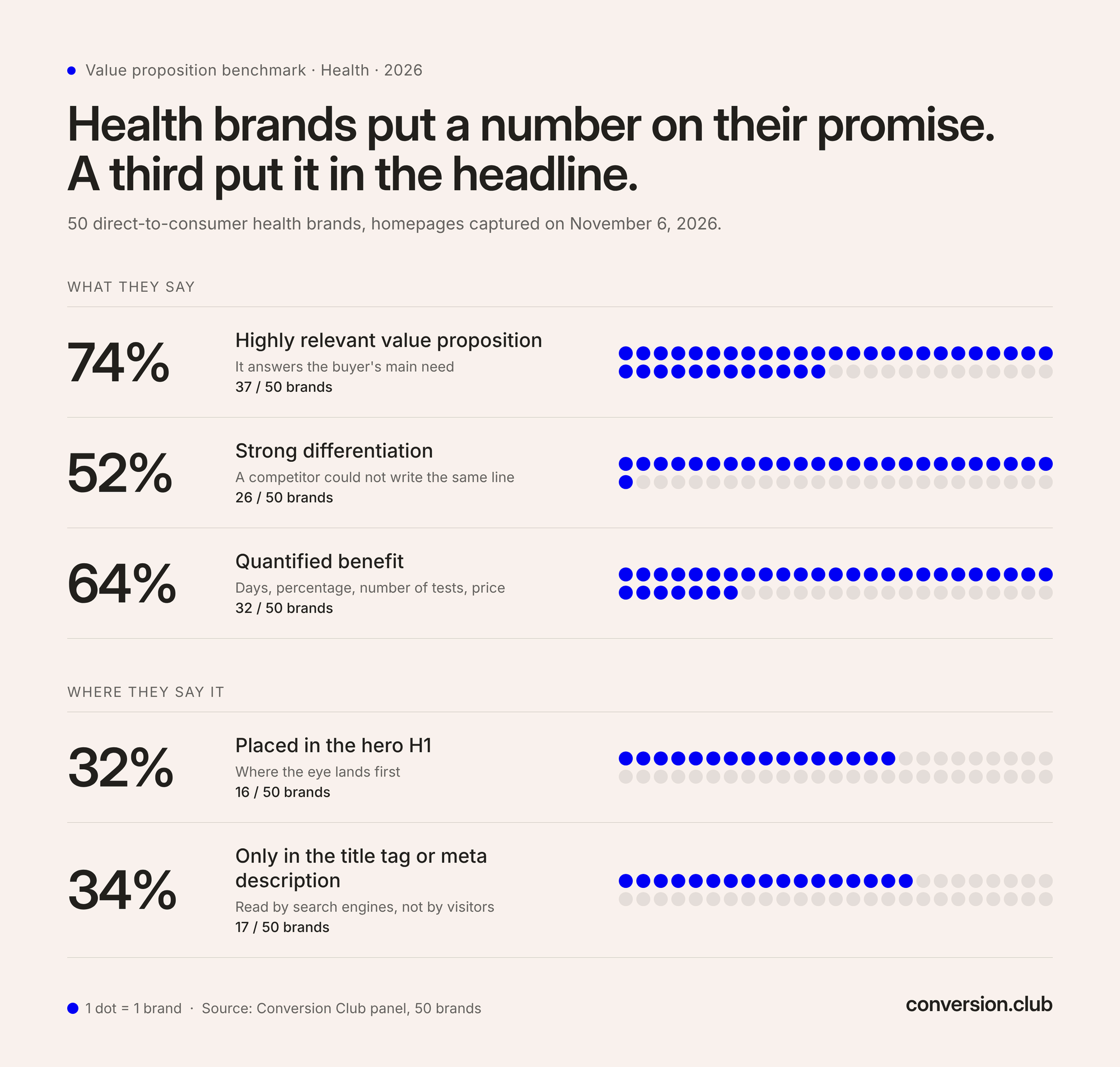
| Metric | Brands | Share of panel |
|---|---|---|
| Value proposition rated highly relevant | 37 / 50 | 74% |
| Strong differentiation (a competitor couldn't write the same sentence) | 26 / 50 | 52% |
| Value proposition placed in the hero H1 | 16 / 50 | 32% |
| Value proposition only in the title or meta description | 17 / 50 | 34% |
| Quantified benefit (days, percentage, number of tests, price) | 32 / 50 | 64% |
What are the best health value propositions?
1. Function Health: Action Over Outcome
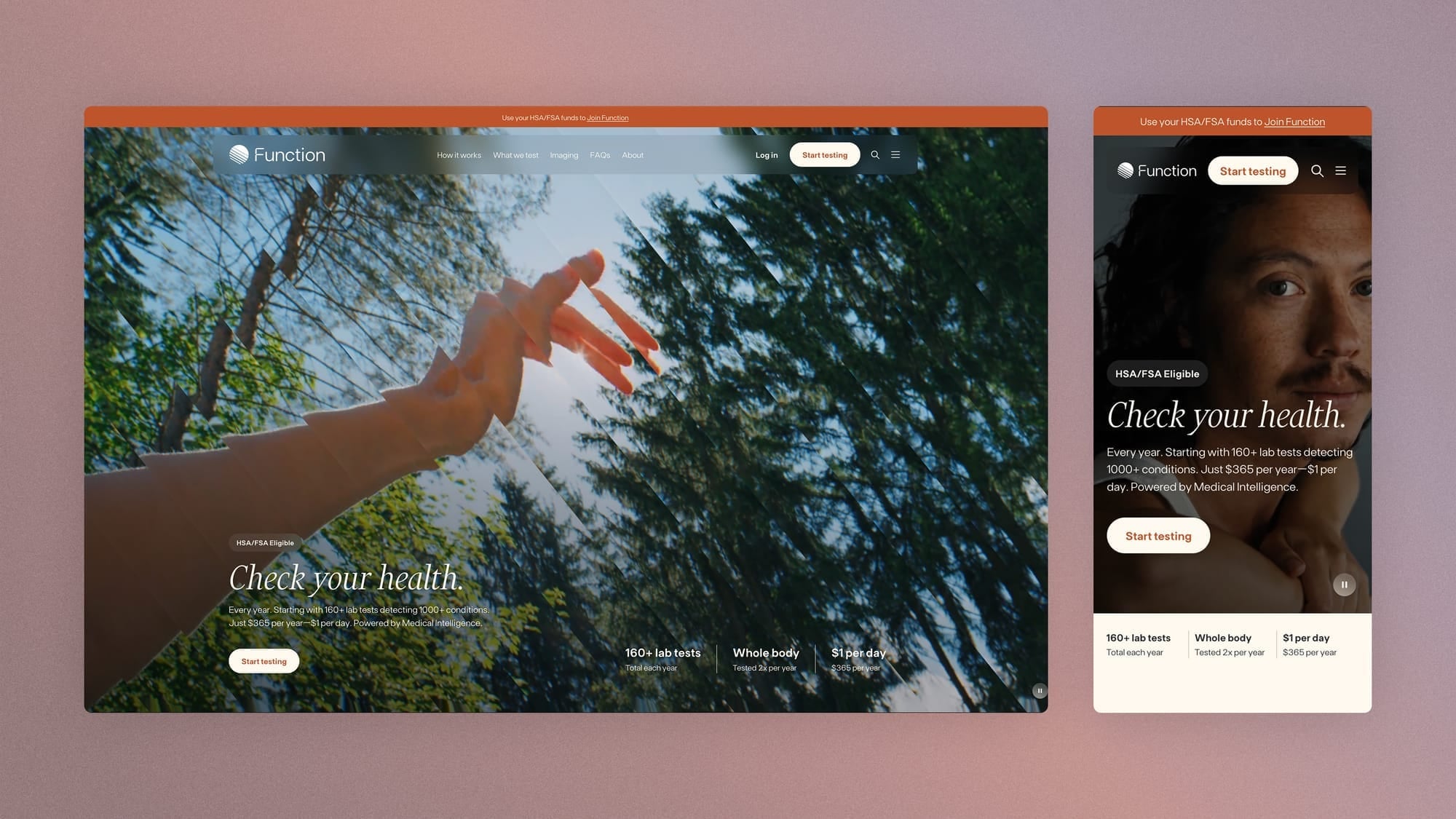
Function Health sells a blood testing subscription. Its H1 is just a few words: "Check your health." The headline gives a simple command, and the subhead carries all the numbers: "Every year. Starting with 160+ lab tests detecting 1000+ conditions. Just $365 per year—$1 per day."
Right below, three steps make the service concrete: 160+ tests across 2,000+ labs or at home, results explained by doctors, then a plan to follow before testing again. Bringing the price down to $1 a day defuses the objection before the pricing grid even appears.
2. Viome: Naming the Failure of Past Solutions
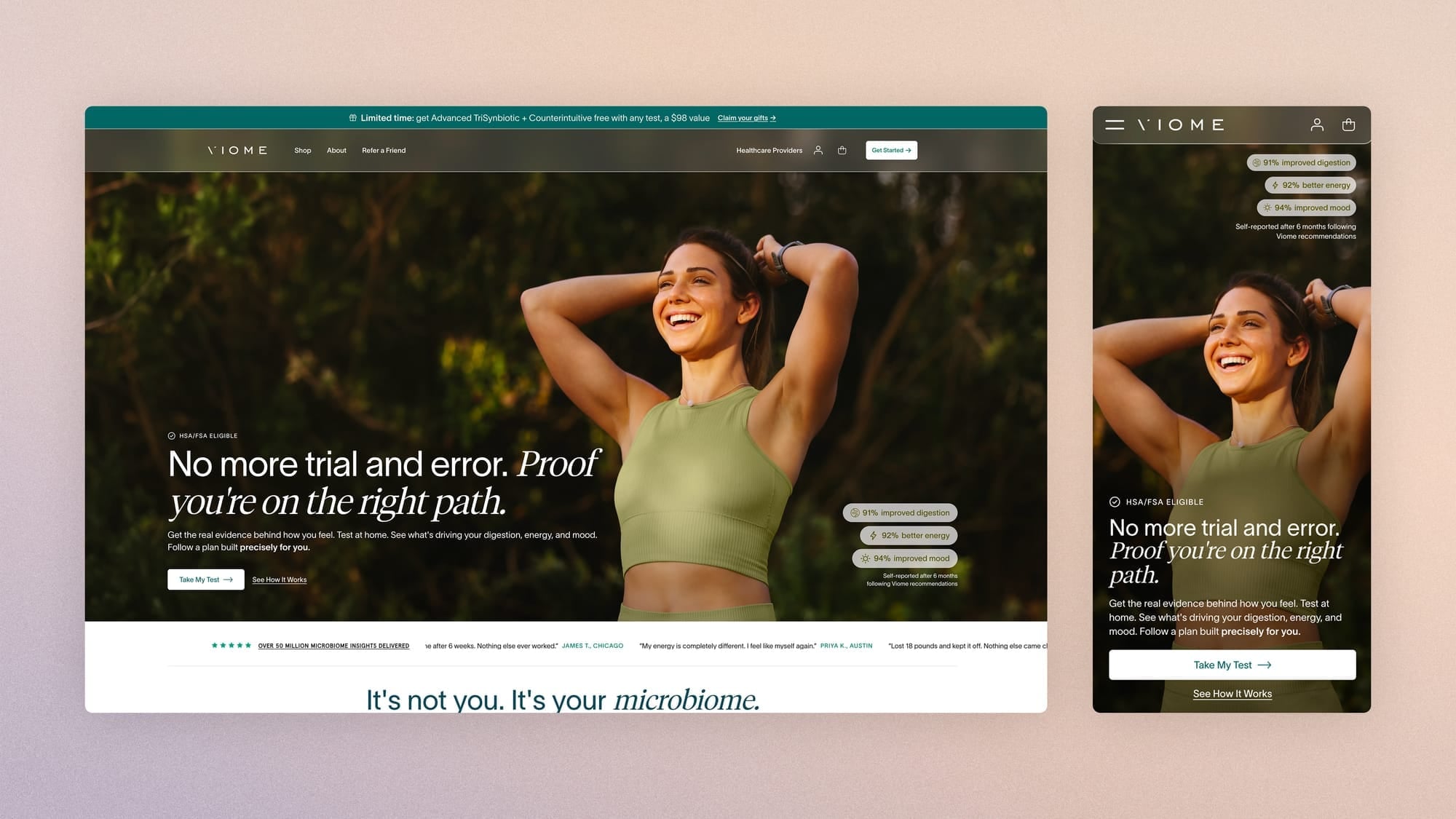
Viome sells at-home microbiome tests. Its H1: "No more trial and error. Proof you're on the right path." The brand speaks to customers who have already tried everything and names their exhaustion before making a promise. The subhead lays out the method: "Get the real evidence behind how you feel. Test at home. See what's driving your digestion, energy, and mood. Follow a plan built precisely for you."
Three numbers follow the button: 91% improved digestion, 92% better energy, 94% improved mood, self-reported after six months of recommendations. Then "over 50 million microbiome insights delivered," and a headline that lifts the guilt: "It's not you. It's your microbiome."
3. Seed: The Dated Benefit
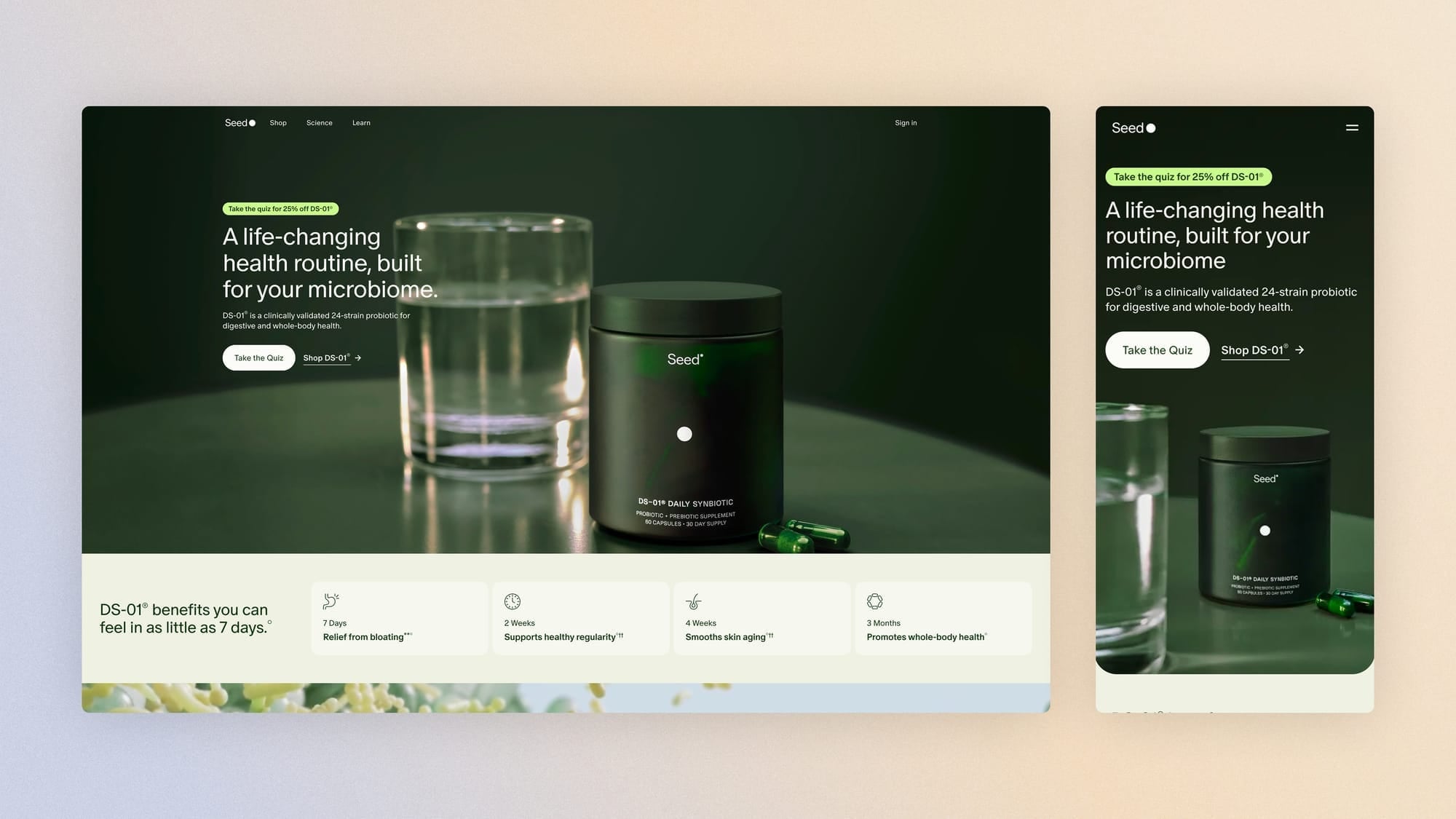
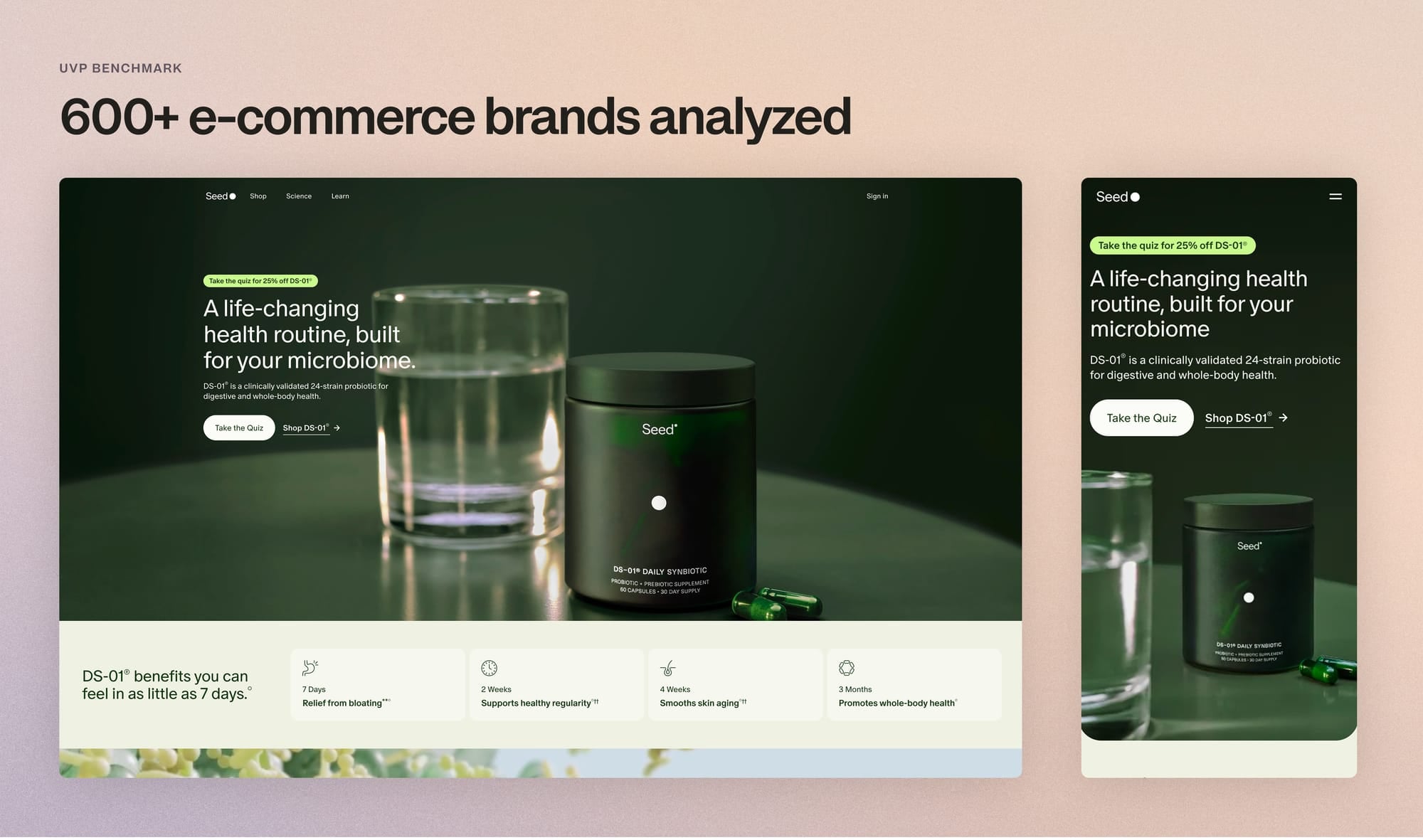
Seed sells subscription probiotics. Its hero headline: "A life-changing health routine, built for your microbiome." The subhead specifies the product: "DS-01® is a clinically validated 24-strain probiotic for digestive and whole-body health." The page has no H1: this headline is tagged as an H2.
The second screen does the real work: "DS-01® benefits you can feel in as little as 7 days," followed by a timeline. 7 days to relieve bloating, 2 weeks for regularity, 4 weeks for skin, 3 months for overall health. The technical proof fits in one sentence: "Most probiotics don't survive digestion—DS-01® does." Further down, the brand claims more than a million transformations.
4. Oura: Aspiration First, Then the Number
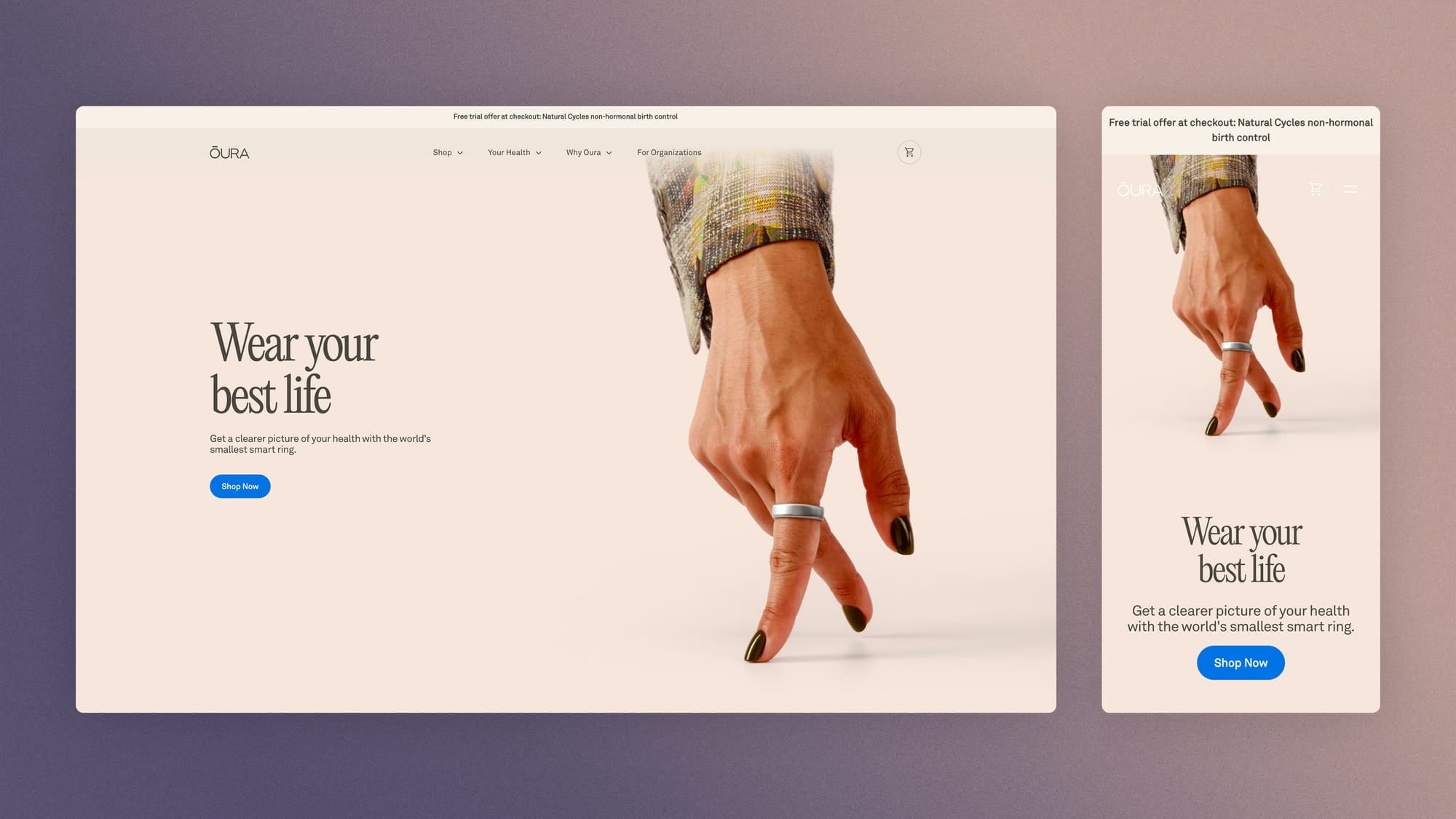
Oura sells a smart ring for health tracking. Its H1 plays on wearing the product: "Wear your best life." The subhead brings it back to something concrete: "Get a clearer picture of your health with the world's smallest smart ring." The second headline turns aspiration into control: "Understand your body. Own your health."
The proof is quantified and sourced: "86% of Oura Members see their health improve," according to a 2026 survey of 3,501 members. The page lists more than 50 tracked metrics, then cites three press reviews: The Guardian, Esquire and CNET.
5. Thinx: Performance in the Competitor's Unit
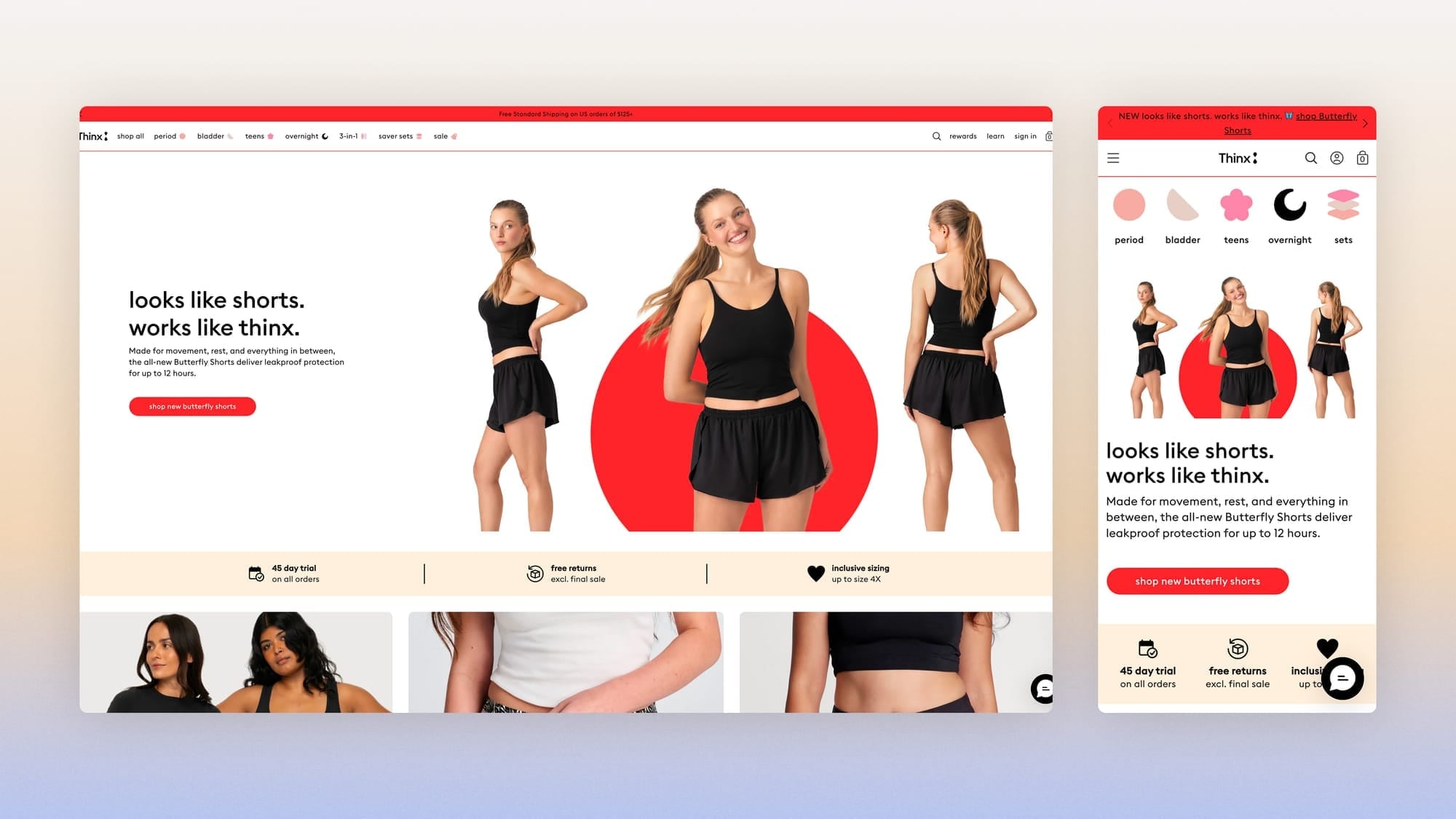
Thinx sells period underwear. The current H1 introduces a new product: "looks like shorts. works like thinx." The value proposition comes further down, in an H2: "absorbs up to 12 regular tampons worth of flow," with an asterisk noting that results may vary.
The sentence gets its strength from the unit it chooses. Nobody knows what milliliters absorbed are worth; everybody knows what 12 tampons are worth. Reassurance proof frames the hero: 45-day trial, free returns, sizes up to 4X, LeakSafe leak barrier.
How did we evaluate the 50 health brands?
Panel: 50 direct-to-consumer health brands (testing, supplements, connected devices, care and hygiene), homepages captured in their English version, scored on 24 criteria.
For health, two criteria weighed more than the others: the source of the displayed number (clinical study, member survey, self-reported) and whether a timeframe for results is given. A quantified promise without a source wasn't counted as differentiating.
Frequently asked questions
How do you quantify a health value proposition without making a medical claim?
By quantifying the service rather than the result: number of tests, days before a first noticeable effect, a familiar comparison unit. Seed promises benefits "in as little as 7 days" and Thinx "12 regular tampons worth of flow," two numbers customers can check for themselves.
Where should you put the number on a health homepage?
In the hero subhead, right under a short H1. Function Health keeps the headline to a few words and puts 160 tests, 1,000 conditions and a dollar a day in the line below.
What is the best health value proposition of 2026?
Viome, "No more trial and error": the headline names the exhaustion of customers who have already tried everything, and the page takes the blame off them before selling the test.
Get the full health value proposition database
This article breaks down 5. The database covers all 50 brands in the health panel, each analyzed on 24 criteria: value proposition and placement, relevance, quantification, differentiation, USP, hero headline, main CTA (text, shape, color), dominant color, visuals, proof displayed, tone and key takeaway.
Ten other segments follow the same grid: B2B, beauty, electronics, food, home, media, fashion, baby and child, specialty and sports. 550 brands in total.
The database is reserved for Le Club members. Signing up is free.
Unique Value Proposition — Full Comparative Analysis
600+ brands · 12 segments · 24 criteria · 14,400 segmented data points