
Two out of three e-commerce brands have a relevant promise.
Fewer than one in three actually show it. We analyzed the homepages of more than 600 brands across 12 verticals and scored each value proposition on 24 criteria: what it promises, where it appears, what it proves.
600 profiles to benchmark yours, spot the tactics that hold up and fix what's missing.
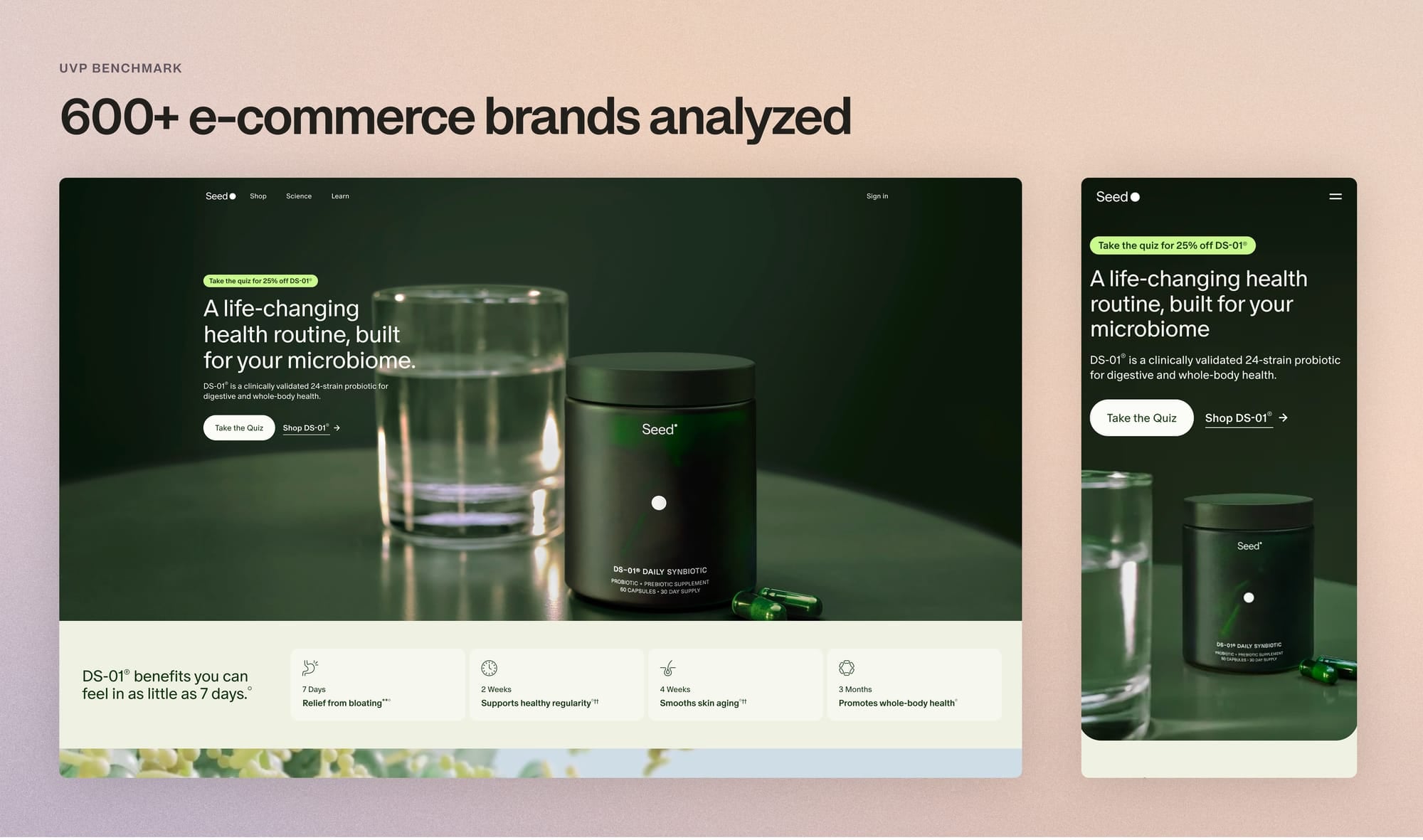
Unique value proposition — Full comparative analysis
600+ brands · 12 segments · 24 criteria · 14,400 segmented data points
A value proposition in e-commerce is the sentence that tells visitors what benefit they get, and why they should get it from you rather than someone else. We judge it on three criteria: how relevant it is to the buyer, how well it stands apart from competitors and whether it includes a quantified benefit.
What does the analysis of 600+ e-commerce value propositions reveal?
Brands know what to promise, but they don't say it clearly. 67% have a highly relevant value proposition. Yet 45% mention it only in the title tag or meta description: Google reads it, but visitors don't. 28% feature it in the hero, and 26% quantify the benefit.
In plain terms, most of your competitors already have a good promise but don't showcase it. The difference comes down to where it sits and the proof behind it, not the idea itself.
What does the database contain for each brand?
The promise
The value proposition word for word, its relevance and differentiation, each one justified, the quantified benefit, the USP. Everything you need to compare yours line by line.
The placement
H1, H2, banner, title tag or meta description. Visible or invisible, this is where everything is decided.
The hero
Visual type, headline, main CTA (text, shape, color), dominant color. The concrete choices behind the promise.
Proof and tone
Trust signals on display, tone, key takeaway. What makes the promise credible, or not.
Compare your hero with those of the 50 brands in your segment and see whether your visitors understand your promise, or whether it only speaks to Google.
Borrow the tactics that work: a quantified benefit in the H1, proof in a banner and a USP that overcomes the last objection. Plan an A/B test based on scored examples rather than hunches.
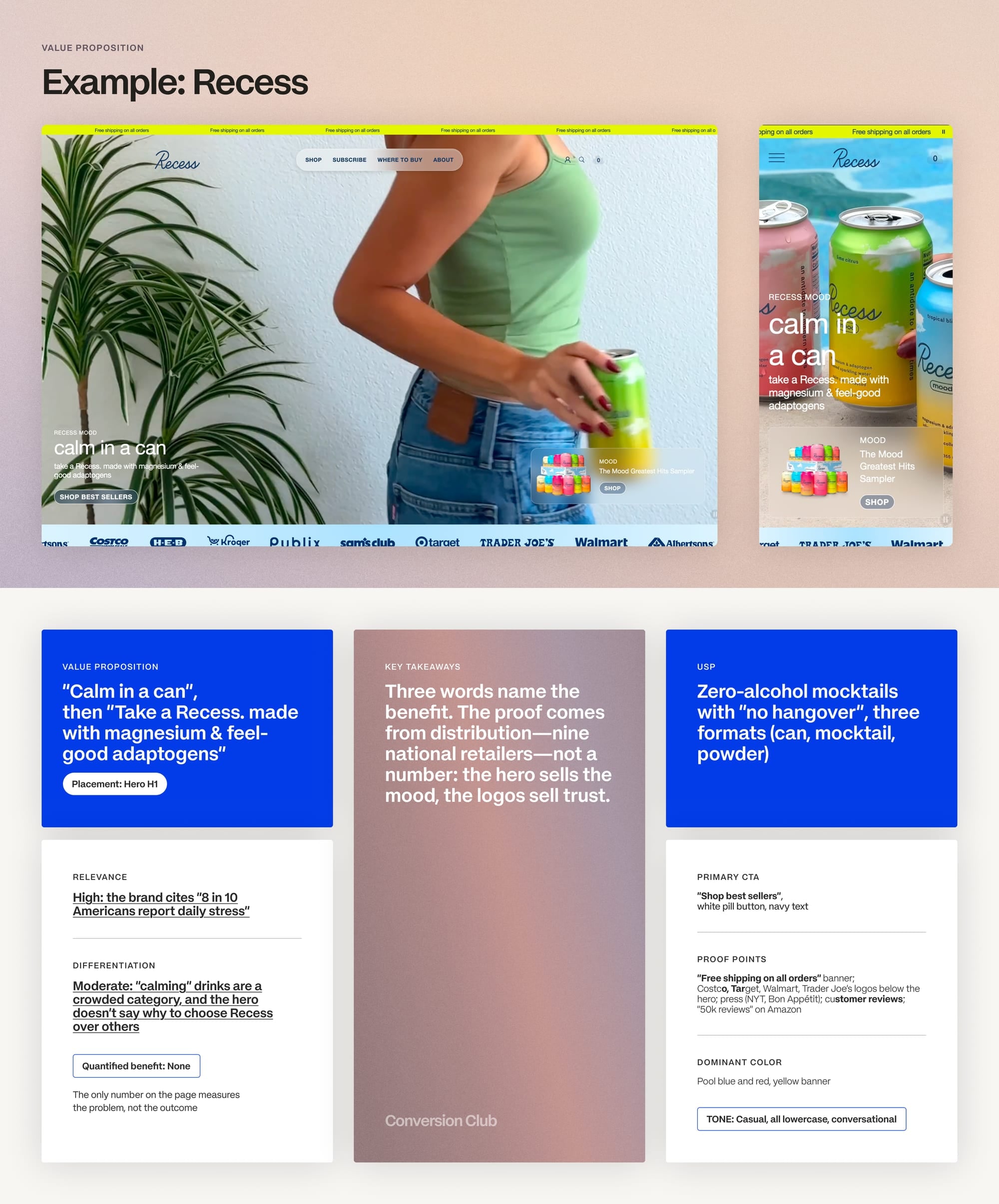
How were the 600 brands analyzed?
Homepages of more than 600 e-commerce sites, with 50 sites per segment, selected by our analysts from industry rankings. Relevance and differentiation are rated on three levels, and every score is justified.
Frequently asked questions
What is a value proposition in e-commerce?
The sentence that tells visitors what benefit they get, and why they should get it from you rather than someone else. In the database, each one is judged on three criteria: how relevant it is to the buyer, how well it stands apart from competitors, and whether it includes a quantified benefit.
Where should you put the value proposition on a homepage?
In the main hero headline, visible without scrolling. In our sample, only 28% of brands do this; 45% state it only in the title tag or meta description.
Which segments does the database cover?
Food, beauty, fashion, home, health, sports, baby products, electronics, media, luxury, B2B and miscellaneous: 50 brands per segment.
Is access free?
Yes. The database is reserved for Conversion Club members, and signing up is free: all you need is an email.
Access the full benchmark
Free database access for Club members. One email, one confirmation click, 600+ profiles.
How it works
Why are the resources locked? Each one takes weeks to build from real audits. Signing up lets us tell you when they change, and keeps them free.
- Enter your emailFree, no card, no commitment.
- Confirm in your inboxOne click on the link we send you.
- Open every resourceChecklists, templates, dashboards and prompts, unlocked for good.