An e-commerce site is a conversation with someone you'll never see. No storefront, no salesperson, no ambient scent: nothing but words. Carefully chosen words, soft words, precise words… behind each one is a voice. Yours.
Brands that hold up their end of this conversation without a false note don't rely on inspiration. They built a system. That system has a name inherited from 2000s marketing, often misunderstood and almost always misused: the brand archetype.
What Is a Brand Archetype? (And Why It Isn't Jung)
Carl Jung never wrote a line about your conversion rate. The twelve-archetype model attributed to him everywhere actually dates from 2001, when Margaret Mark and Carol S. Pearson published The Hero and the Outlaw: twelve narrative figures (the Hero, the Outlaw, the Lover, the Sage and eight others) organized around four fundamental desires:
- leaving a mark on the world,
- reaching a form of paradise,
- bringing order to chaos,
- building connection.
The model is a commercial adaptation of Jung's theories… with one catch: any behavior can be tied to an archetype after the fact, which makes the theory as questionable as it is irrefutable. It's closer to astrology or mythology than to empirical science.
If a theoretical framework can explain everything, it explains nothing rigorously.
So why use it?
Because its value isn't psychological. It's operational. In practice, a brand archetype is a narrative framework that fixes a brand's voice (its central promise, its vocabulary, its taboos) and acts as a tiebreaker for every writing decision along the customer journey.
An archetype won't magically reveal your brand's personality. But it will stop you from having twelve of them!
Every week, an e-commerce brand makes dozens of small writing decisions that nobody actually arbitrates (except the CRO A/B testing obsessives): the button label, the out-of-stock message, the abandoned cart email subject line, the 404 page.
Without a system, each decision takes on the mood of the day, and inconsistency quickly starts to show.
The archetype then becomes a tiebreaker: it doesn't tell you who you are, it tells you how to decide.
The 12 Brand Archetypes: The Full List With Examples
The twelve figures, what each one promises, and a brand that embodies it:
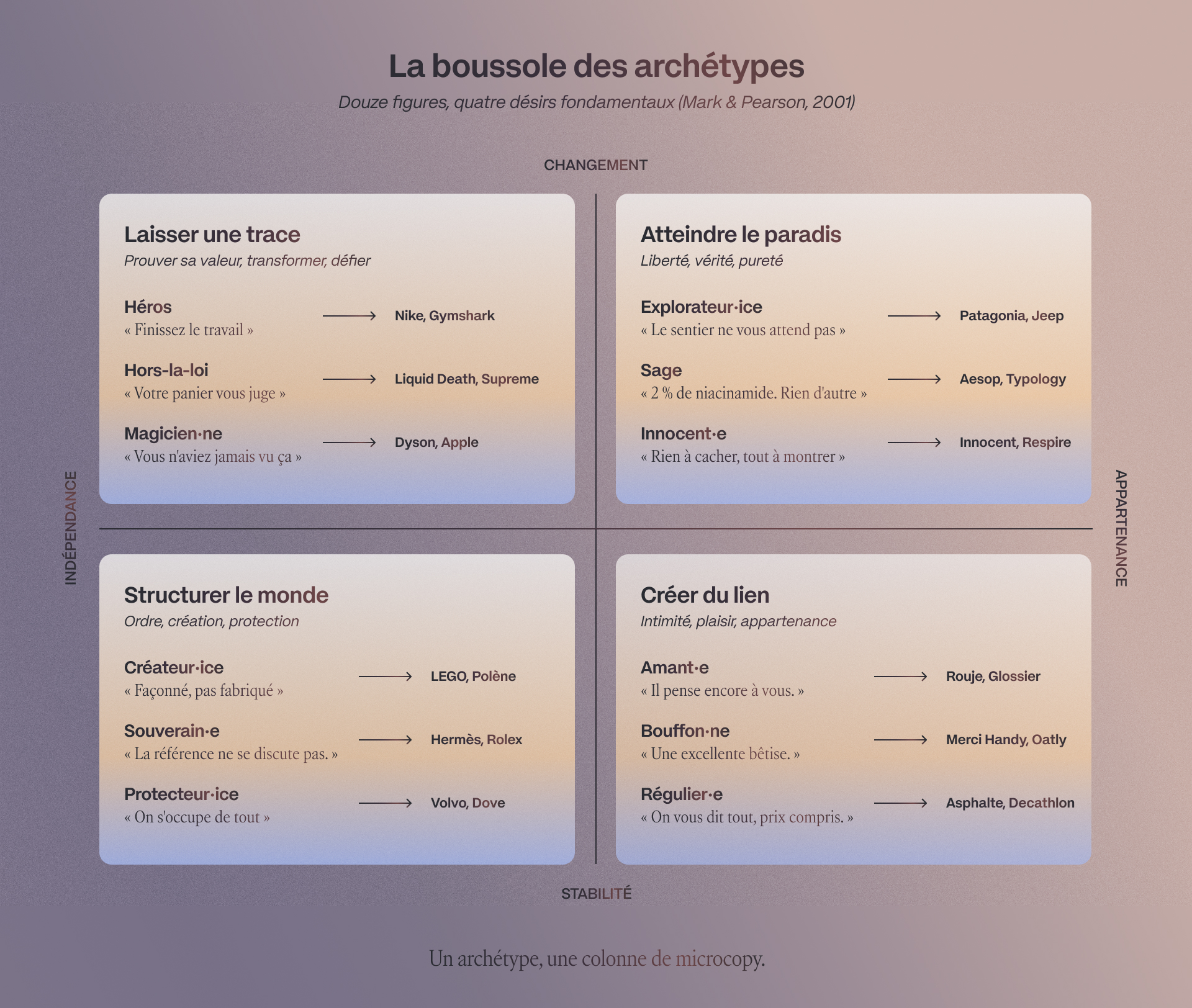
| Core desire | Archetype | The promise | A brand that embodies it |
|---|---|---|---|
| Leave a mark | Hero | Victory over yourself | Nike, Gymshark |
| Magician | Transformation | Dyson | |
| Outlaw | Transgression | Liquid Death | |
| Reach paradise | Explorer | Freedom | Patagonia |
| Sage | Truth | Aesop, Typology | |
| Innocent | Simplicity | Innocent, Respire | |
| Bring order to the world | Creator | The work that lasts | Polène, Lego |
| Ruler | The benchmark | Hermès | |
| Caregiver | Care | Mustela | |
| Build connection | Everyman | Belonging | Asphalte, Decathlon |
| Jester | Fun | Merci Handy | |
| Lover | Intimacy | Rouje |

Brand Archetype, Customer Archetype: Mirror or Aspiration
On the brand side: the archetype defines the voice
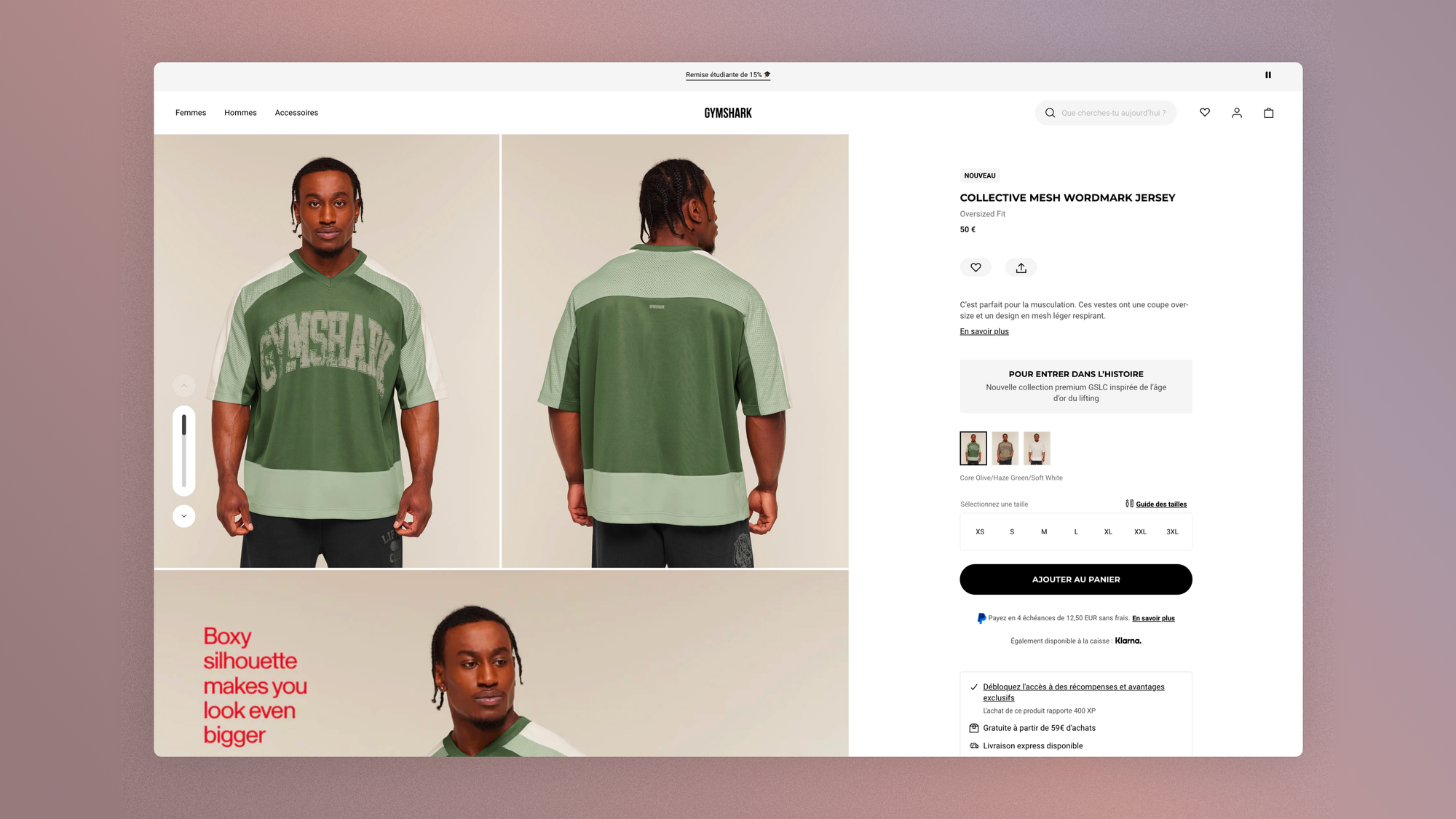
Nike embodies the Hero: "Just Do It" is an imperative, not a suggestion. Just F*cking Do It.
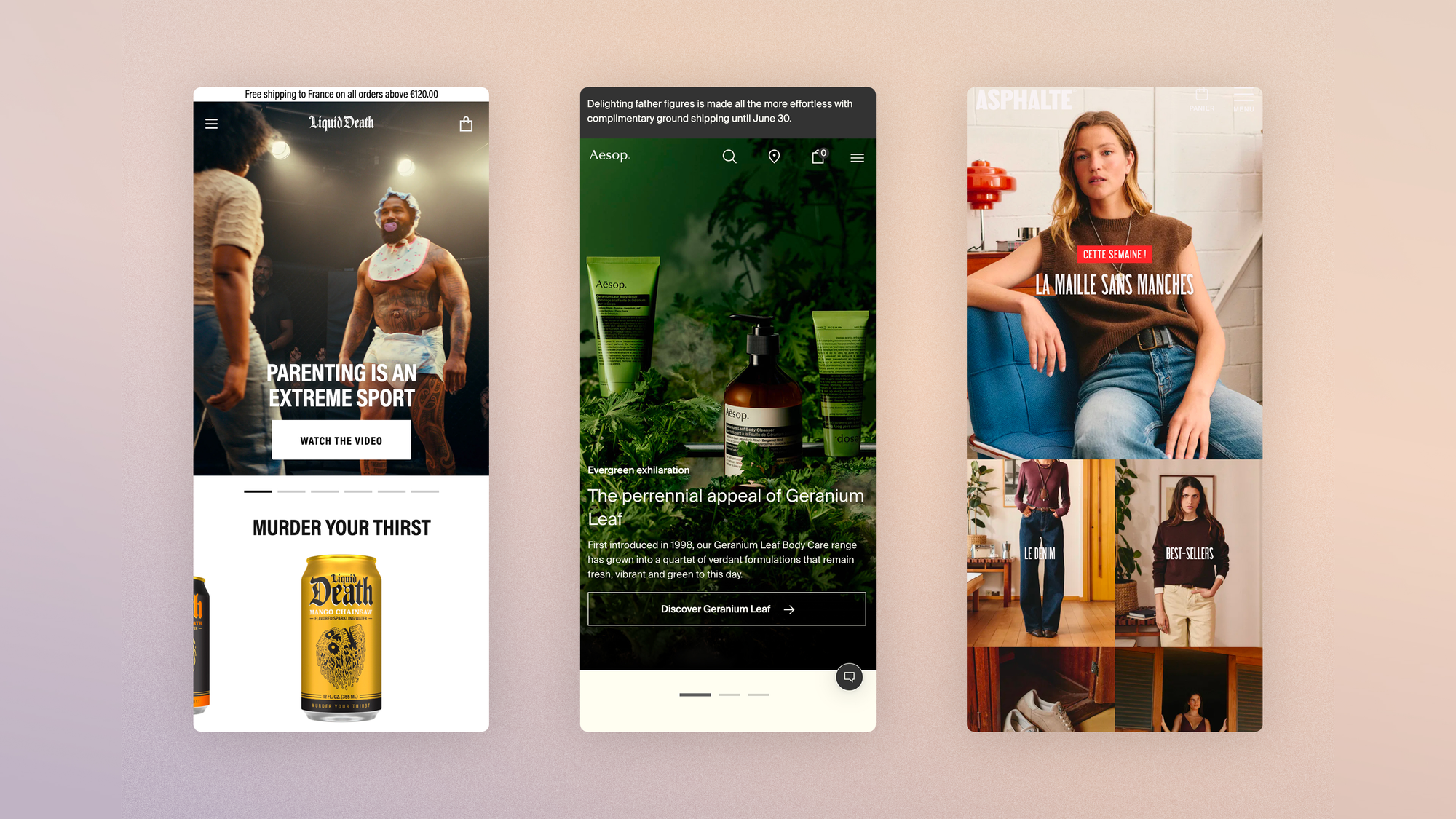
Liquid Death built the most profitable Outlaw of the decade: canned water sold like a metal band, "Murder Your Thirst" as its banner, and a valuation of about $1.4 billion six years after launch.
At Aesop, the Sage writes product pages like entries in a literary pharmacopoeia.
The French market has its own mythology too: Rouje pushed the Lover to its logical extreme, a whole wardrobe built around one silhouette and a red lipstick worn as a signature.
Asphalte speaks Everyman, that workshop-buddy "we" that announces cost prices and production delays with the same candor. Merci Handy slips the Jester into its instruction manuals.
On the customer side: the identity gap
Every customer arrives with two versions of themselves: the one that exists and the one they want to become. The purchase lives in that gap.
To put it simply: you don't buy leggings, you buy the person who'll go running tomorrow morning (or who, at the very least, will download the running app). No judgment.
In reality, the real strategic choice is the relationship between the subject and the object, and there are two options to work with:
Mirror or aspiration: the two strategies
The mirror
Typology speaks Sage to customers who already read INCI ingredient lists. The brand reflects what its audience is.
The inspiration
Gymshark speaks Hero to people who haven't yet set foot in a gym. The brand embodies what the audience wants to become. Both work. What doesn't work is not choosing.
Why Archetypes Drive Conversion: The NN/g and Baymard Studies
Two bodies of research intersect here, and each sheds light on what the other doesn't measure.
The Nielsen Norman Group measured the effect of tone of voice on brand perception: with strictly identical content, tone measurably changes how likable, trustworthy and desirable people find an organization.
And in their study, trust is the pivot: respondents say they're significantly more likely to recommend and buy from a brand they see as trustworthy.
The Baymard Institute, for its part, has documented what happens when voice is missing.
In their large-scale user tests, every single participant relies on the product description to decide. Yet the same participants regularly call those descriptions "bland" and "boring," and spend less time on product pages that would actually suit them.
Worse: faced with inadequate descriptions, some users abandon the product, then the site, assuming that one thin product page signals thin pages everywhere.
The takeaway fits in one sentence: information drives conversion, voice drives preference, and the archetype drives consistency across a whole catalog.
How to Find Your Brand's Archetype: 3 Tests (No Horoscopes)
The classic mistake is picking your archetype in a meeting, through introspection ("We feel like more of an Explorer, right?"). You end up with a brand horoscope: flattering and interchangeable.
The right test doesn't probe what the brand thinks it is. It looks at data.
Test 1: customer reviews
Reread your last fifty customer reviews and highlight what keeps coming up.
Not the adjectives about the product: the verbs about life. "I feel," "I finally dare," "I'm getting back," "I discovered." These verbs point to one of the compass's four desires. Your customers' real desire, not the one on your moodboard.
Test 2: the forbidden sentence
Write the sentence your direct competitor could never publish without betraying itself. If you can't find one, you don't have an archetype yet. You have a price positioning.
Test 3: customer support under pressure
Reread your recent replies to an angry customer. The voice that comes out under pressure is your real archetype; everything else is homepage decoration. If your support tone contradicts your site's tone, support is telling the truth.
Let's be honest: nobody has time to spend hours on this kind of test, yet the value is high. So we put together a complete prompt you can paste as is, with your data, into your favorite LLM. You'll find it at the end of the article.
Microcopy by Archetype: CTA, Out of Stock, Abandoned Cart
Here is the same purchase journey written three times, in three different systems:
| Touchpoint | Generic version | Hero | Lover | Outlaw |
|---|---|---|---|---|
| Product CTA | Add to cart | Let's go. | It's yours. | Grab it before we change our minds. |
| Out of stock | Product unavailable | Gone too fast. Next time, be first. | It slipped away. We'll let you know as soon as it's back, promise. | Too late. We warned you. |
| Abandoned cart | You forgot something | You were so close. Finish the job. | It's still thinking about you. | Your cart is judging you. |
| Order confirmation | Your order is confirmed | Done. Well played. | We're preparing it with care. | You just made an excellent mistake. |
- Read each column vertically: it tells the story of an entire brand.
- Read the rows horizontally: no version is better in the absolute. Each one is better for the brand that chose it.
That's exactly the system's job: you don't judge microcopy in isolation, you judge it on consistency. Two simple rules to remember:
The archetype is expressed, not recited
If the word "bold" appears in all your messages, you don't have an archetype, you have a party theme (mic drop?)
The Outlaw never says it's a rebel. It just writes "Your cart is judging you" and lets you draw the conclusion.
Test the column, not the cell
An A/B test on an isolated CTA measures the performance of one wording, but what you want to build is consistency across a whole journey. That's the effect to examine (open rates of lifecycle emails, repeat purchase, share of branded traffic in acquisition), not the button alone.
Read also:
 Robin Marzin
Where the Archetype Should Go Quiet: Checkout, Shipping, Returns
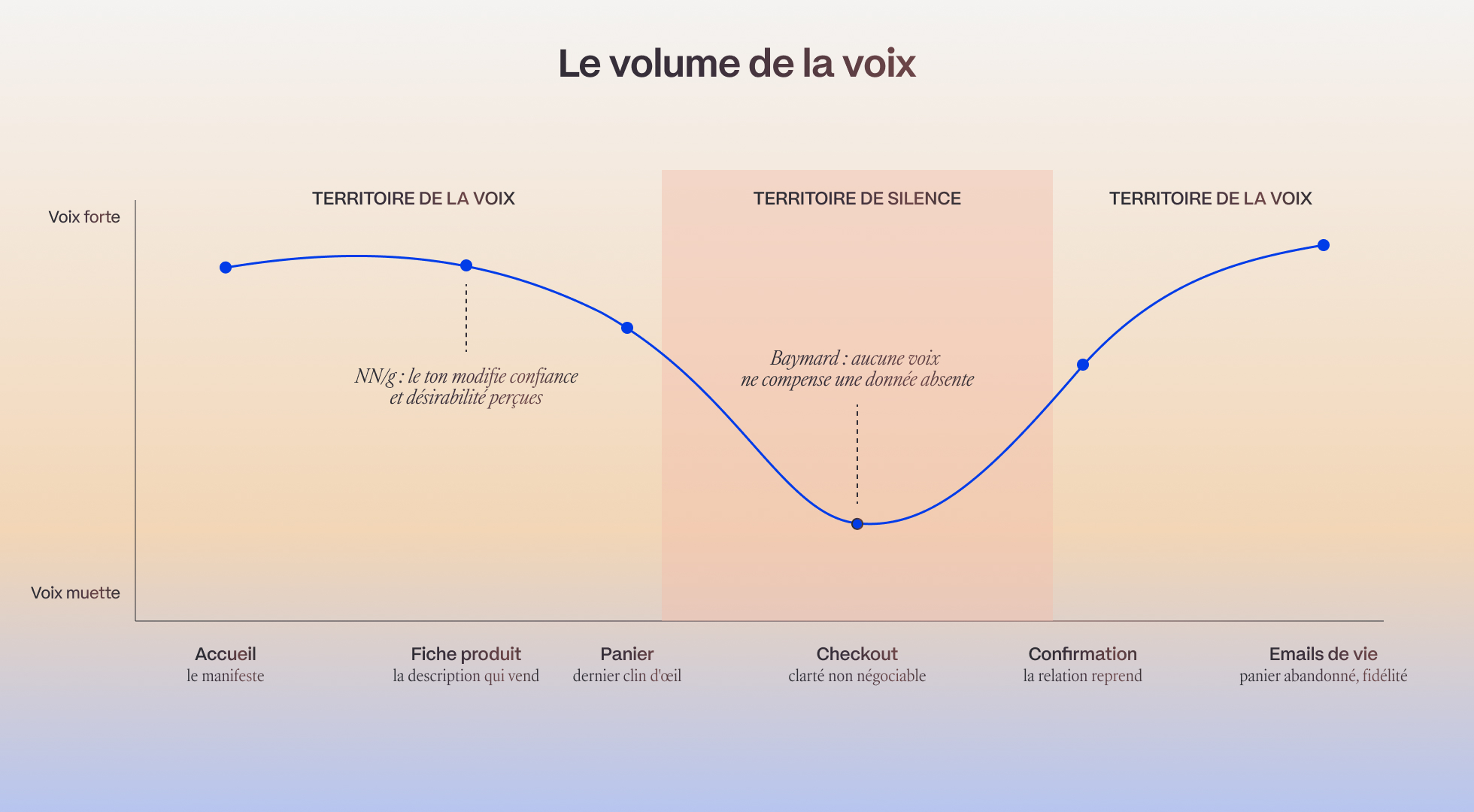
Baymard's 200,000 hours of research say one stubborn thing: when users are looking for information (delivery time, return policy, order total), nothing replaces information. No voice makes up for missing data.
Liquid Death, again: the brand threatens to murder your thirst on the can, then very politely asks for your ZIP code at checkout.
The most sensible checkout on the market belongs to the loudest brand, and that's not inconsistent. It's simply hierarchy: clarity first, character on top.
Voice speaks loudly where customers dream (homepage, product page, emails) and drops a notch where they act (cart, payment, order tracking).
The journey draws a U: loud at the entrance, almost silent at payment, loud again after the purchase, when the relationship resumes.
A simple rule for settling every disputed case:
If the customer has to reread, the archetype has lost.
Brand Archetypes and AI: Voice as Differentiation
Back to the identity gap: if people buy a slightly better version of themselves, the brand's role isn't to flatter that version but to be its credible witness. Credible because consistent, and consistent because systematic.
Yet something is subtly shifting. As you may suspect, a growing share of the web's product pages is now written by (and for!) language models, and those texts are converging on the same polite, interchangeable tone.
E-commerce is filling up with an average voice, the kind you tend to forget because you've heard it too much.
The archetype's status changes. It's no longer a brand refinement: it becomes the specification that keeps your prompt from producing exactly what your competitor's produces.
And it may become something else, something we're only starting to measure. On a web read by machines, the distinct voice is the one that gets cited. AI knows how to write "correct," but it can't (or can't yet) write someone.
Brands that stay someone will soon speak to two audiences at once: the humans who buy, and the models that recommend.
Read also:
 Jérémie Werner

FAQ
What is a brand archetype?
A brand archetype is a narrative framework, drawn from the model by Margaret Mark and Carol S. Pearson (2001), that fixes a brand's voice around a central promise: victory for the Hero, intimacy for the Lover, transgression for the Outlaw.
In e-commerce, it acts as a tiebreaker for all small writing decisions: CTAs, out-of-stock messages, abandoned cart emails, the 404 page.
How do you determine your brand's archetype?
Not through introspection, but through observation. Three tests are enough: reread your last fifty customer reviews and highlight the life verbs ("I finally dare," "I'm getting back"), write the sentence your direct competitor could never publish, and reread your support replies written under pressure.
The voice that comes out under pressure is the real archetype. If it contradicts the site's tone, it's the one telling the truth.
How many brand archetypes are there?
Twelve, organized around four fundamental desires: leaving a mark (Hero, Magician, Outlaw), reaching paradise (Explorer, Sage, Innocent), bringing order to the world (Creator, Ruler, Caregiver) and building connection (Everyman, Jester, Lover).
A brand picks only one dominant archetype, and that's precisely what makes the system useful.
Do brand archetypes still matter in the age of AI?
More than ever.
When a growing share of e-commerce copy is generated by language models, the average tone becomes the norm.
The archetype then becomes the specification that sets your prompts apart from your competitors'. And on a web read by machines, the distinct voice is the one that gets cited and recommended.
Find your archetype
The complete prompt (the three tests, the twelve-archetype grid and the output format) is ready to paste into your favorite LLM with your own data. It's reserved for Conversion Club members.
Access the prompt:
 Jérémie Werner